As a modern man, and a person living in our world I understand the need for tolerance, but of what should we be tolerant? And where should we draw the line?
Tolerance is along the same lines as endurance. There are many things which we must endure day-to-day, year-to-year, and through the generations.
When someone needs to live somewhere for a job or just because they can't get away (or wants to live there, but that is outside of this consideration) they must tolerate the weather. Snow, ice, cold, rain, heat, drought and many other conditions that we must live with. What do people do with the weather?
First they tolerate it and buy appropriate clothing, coats, hats, shorts, whatever would make walking through the weather more tolerable. This is a terribly important step that many animals don't have the luxury of, in fact it is why humans can survive in such varied conditions, even those who are acclimatized to Hawaii can make do with a few extra layers farther north.
We insulate ourselves and take other precautions in all ranges of weather. Sure there are those perfect days where clothing can be minimal, but for those of my translucent-skinned brethren we still apply a layer of sunblock. We could go to an extreme insulating ourselves by building shelters that we never have to leave, but there are so many problems that arise. Though those the problems have been mitigated via "happy-lights" and carefully choosing the winter crew for Antarctica, we are never truly insulated from our surroundings. Astronauts on spacewalk have air leaking out of joints in the gloves still, and space is far more hostile than any but the most severe weather event on earth.
Second they talk about it. Complain in fact. But what is the most boring conversation starter? "How about the weather?" Or something similar. When you run out of stuff you are comfortable talking about you fall back to the weather. Now that gets me thinking about how often I talk about the weather, maybe because I don't know people well enough to ask them about other things? Anyway, it is a mundane subject that is generally considered inoffensive because everyone is in the same boat. When farmers are hit by the drought, they talk about it. The news loves talking about extreme weather events...
Third they try to change it. Cloud seeders, I haven't seen any hard evidence that these are successful all the time, in fact in the past there may have been many frauds just trying to get farmer's dwindling money. The funny thing is that we are changing the climate every day. If in chaos theory it merely takes a butterfly flapping its wings half-way around the world to start a hurricane, than how much more air is each one of us moving by driving, or even shaking hands on a business deal?
So where am I going with this? Tolerance.
We can never shut out the weather completely, so we must tolerate it, and everyone has their own coping mechanisms from embracing to denying. But should we tolerate other things that make up our climate? And by climate I mean social climate. I am sure there are tens of thousands of blogs that call for tolerance for one thing or another, and many others that are specifically or generally intolerant.
It is also quite over-discussed in groups of geeky friends, philosophy classrooms, and governments (at least I hope). Tolerance is a buzzword in religion too, and should we be tolerant of other religions? Well let apply weather as an extended metaphor to social climate:
Let us say you have a social climate that you are most comfortable with, friends, family, and people you deal with often enough to know well and not feel anxious around. You also have a meteorological climate in which you feel most comfortable. Stick with me because we are going to dump both, you move to a new town with much different weather, and know absolutely no one. As a bonus this town is far enough away that all the things you might consider social norms are turned around and nothing seems to make sense.
I speak with some experience on this point, I moved from Wyoming to Hawaii, quite a contrast. So what do you do? Insulation, talk, and try to change it? Maybe, let's just say I have decent insulation, but not so much I don't know what's going on and can't talk to locals, however my closest friends tend to be more like me than like locals. I talk about the funny things I hear, with friends, but also with locals, we share a common experience. Have I tried to change it? Sure, I have helped introduce the sport of fencing to quite a few people on the island. So yes I have adapted to the climate as well as having a bit of impact on it.
Now here is a bigger leap, a deeper dig: Tolerance: the ability or willingness to tolerate something, in particular the existence of opinions or behavior that one does not necessarily agree with. So can I be a tolerant Christian, and moreover a tolerant Christian man? I just lost a whole bunch of nonexistent readers right there.
I believe the answer is a resounding "YES." There, hopefully some people who were about to leave stayed around. And now I am about to lose more: Christ said in reference to the Romans occupying Judea, that Christians must give up their cloaks, carry items, and turn the other cheek. Severe paraphrasing, either ask me or go look it up and correct me. In that age this was tolerating the Roman military who had the right to ask citizens for materials and labor, and could hand out minor corporal punishment on a whim.
So several thousand years later we have gone from being an oppressed minority to pressing our views on others. Personally I don't believe this is oppressing, not that we are killing about it much anymore, unlike some other religious groups I could name. However, we as the "Church" (big 'c' to indicate all Christians) are insistent on pressing our views on people via government laws and group social pressure. "Be like us and enjoy the fruits of our hypocritical actions." I am sure that someone is thinking that right now without the "hypocritical." But Christianity is not about the human institutions, despite nearly two millennia of human institutions "devoted" to Christ.
Tolerance isn't about institutions unless it comes to protecting someone from intolerance. There are many movements that I disagree with in today's social climate, and no, not all of them are considered socially liberal. I could list them and tell you why I disagree with them, but I do not write to change your mind about any particular movement, I write to change or reinforce your attitude about tolerance.
In fact, I urge you to tolerate any non-threatening movement. Now the other half of my non-existent audience are leaving. Tolerance is not agreeing, it isn't acquiescing. I have my morals and believe that some things are wrong and that other even-more-wrong-headed individuals will push things down slopes without friction.
But that is the thing, tolerating, not acquiescing. I am not about to go out in a Wyoming winter storm without proper gear, and I certainly won't acquiesce to the universe's insistence on normalizing temperature gradients to match the bitter cold of my surroundings, forget it. That's what irks me is the insistence of acquiescence from any side. "You must tolerate us!" But what those groups do, including my groups, is change the tone to imply that tolerance is no longer enough, tolerance now means to acquiesce to demands. And the real victories come when they are able to institutionalize it so that any stray word or thought can be persecuted.
It is based on individuals, not institutions. I know many people with different views. Do I tolerate their views? Yes, except where they are in danger of harming themselves or others, and generally a gentle explanation can straighten out obviously ridiculous views, unless they are in the fanatic camp. Should I insist they follow my views? Should they insist I follow their views? No, in most cases. But then how can I be a good Christian and convert those people I come in contact with? Isn't that the whole idea? Yes it is, but it isn't for me to push my views on you, I may express them and step out of participating in something that I have opposing views to. I believe that if you find my views to be better than yours for some reason that you will come talk to me, and I wish others would extend the same courtesy to others outside their own groups.
We should discuss, we should debate, we should listen, we should tolerate, but we should also be aware that tolerance is not acquiescence. I reserve the right to my views. In a previous post I recounted how my views on data changed, there are many other things I have negative views of that could in fact change, and I don't believe any of them are harmful to any individual, but I must strike down this pedestal before it gets too high.
So now the reason behind this epic: I believe the protesters blocking TMT groundbreaking are incorrect and too late. That is my opinion, I ask you tolerate it, but in this I would also love to go beyond just insulation and talk about it, and maybe even change the climate. I will leave it at that.
*updated November 2016 with mostly links
Tuesday, October 07, 2014
Saturday, October 04, 2014
To Take or Not to Take the Subway
Introduction to Data Science Capstone
Udacity
The New York Subway system spans 842 miles of track with 468 stations and transports about 5 million people a day. But those are just large numbers, first we need to get a feel for the data. What does the precipitation look like throughout the year? What does the ridership look like on an average day? Can we predict ridership with the given information?
The dataset I am using to answer these questions is turnstile data from 2013 collected over the entire city, however, I am limiting mine to the most consistent station for reporting data: Wall Street. I also signed up for an API on Weather Underground to get hourly data for the same year. Let’s take a look at precipitation throughout 2013.
 |
| Precipitation in New York 2013: Shows rain and snow amounts throughout the year. |
This graph has all 365 days of the year with the precipitation of each hour arrayed along the horizontal axis. The alpha of the dots shows us the intensity of the rain in the hour. The most intense rain in an hour recorded 1.06 inches. Given that information and that the alpha setting needs to be between 0 and 1, I normalized all the rest of the rain data against that value giving us an alpha gradient and a decent visualization.
It gives us a sense of the precipitation, but we also need a good view of ridership throughout the year. However just creating a line graph or a scatter plot won’t really help us visualize the data. The first thing to try would be averaging all the hours to get an average day’s ridership.
After some file size issues, data had glitches from when a turnstile would cut-out, and I also found that the reporting time of every four hours to be problematic, especially when a single turnstile would report during an off hour.

I found that the only station to get nearly continuous updates was the Wall Street station. It is only missing a total of 21 reports for the entire year. So I ran it through a series of filters designed to get rid of steps and glitches and came up with a graph that looks much more like a counting line:
Running it through some SQL queries in pandas I got the average ridership per hour so that we can compare it to our rain data, at least visually.

The interesting thing with the entries data is that morning rush hour is quite a bit more than the really early morning, but it never really slacks off at lunchtime, in fact there are more and more entries until a peak of about 2,750 entries at 18:00.
But does this correspond at all to our weather data? As it has one similar axis I could flip it so that the axes match up and then have a dual axis along the bottom.
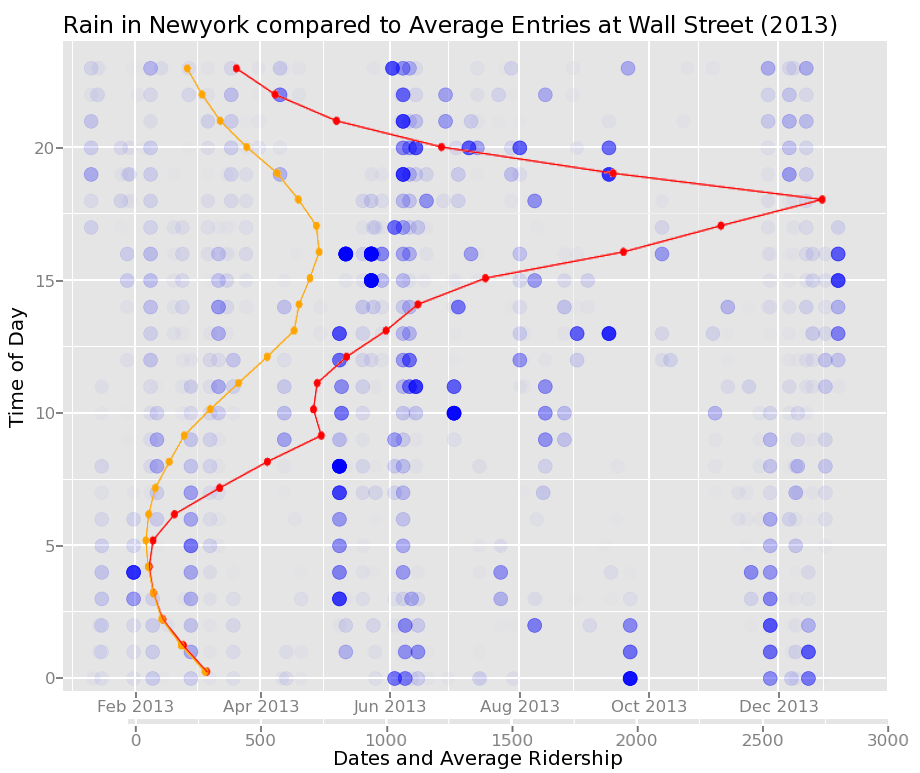
This is the result with the red line as the average day/workday throughout the year and the orange line denoting the weekend days. It might just be a fluke of the climate, but it seems June’s heavy rain-showers correspond quite nicely with the uptick in traffic at 18:00. However, this is also about the time most people are leaving the non-residential district to head back home after a day of, ironically, pushing numbers to get better results.
Although visually biasing the graph really doesn't tell us what we want to know, and this is where we turn to regression.

It seems that the best predictor of subway foot traffic is time. With over a thousand more hours predicted within 1000 commuters compared to using just weather, which is more than ten percent of the data set, deciding when to ride the subway will affect the number of people riding with you more than if it is raining.
However, I was wondering what a different algorithm might be able to tell us. What might a machine learning model be able to predict, possibly trained on different parts of the year? So I turned to scikit-learn to go through a few different algorithms.
At first I tried a Bayesian Ridge which is very similar to the algorithm used in the class and that I modified to use on this data. Its results were nearly the same, although I was able to get some very interesting overfitting using the entirety of the year as a learning set. Otherwise it seemed that somewhere in April had a set of data that was the best at predicting the entire year. When I checked the r-squared value I was a bit surprised: 0.23. Not as good as I was hoping despite the graphs showing much of the predictions within one thousand passengers.
 |
| AdaBoost compares quite favorably to the regression used in class. It also has an r-squared value of nearly 0.53. |
 |
| Both algorithms have problems predicting the evening rush-hour numbers, however AdaBoost seems to recover for later in the night. |
I also tried the AdaBoost algorithm which sets up multiple prediction agents rather than just weight the inputs. With this algorithm the predictions got an r-squared of 0.52, quite a bit better. Still the driving factor behind all of these predictions is time, and I could probably get an even better result by separating the weekends and holidays out of the weekdays. And a problem with the AdaBoost algorithm: it isn’t completely repeatable with minimum controls as it gives a different distribution each time, but seems to maintain the r-squared value.
 |
| Difference of ridership against prediction (red) and precipitation (blue) show that not the prediction algorithm was not greatly affected by precipitation, getting predictions nearly right and quite wrong. The deepest red dots are predictions off by nearly twice the highest average traffic, about 6000 riders. |
Generally it seems that the majority of people using the Wall Street station use it all of the time, that and the people who don’t either continue walking or using other transportation despite most weather.
The last thing to consider is the different mapreduce options. First of all the whole dataset isn’t truly that large, at 60MB it certainly bogged down my computer and ran into system timeouts, but removing those limits and putting in a few more Gigs of RAM to deal with copies easily would go a long way to solve these problems, not really in the realm of true need of MapReduce.
To get into this realm we might look at something that could be a bit more complicated. Real time tracking of entrances and exits on the subway system to get a much finer grain picture of the entire system would certainly get close to qualifying, especially if you wanted to more than just swim in the data.
Another future application of real time systems maybe routing traffic with a pay-or-get-paid system for taking city-wide data and destinations and crunching it down to route traffic. If a person needs to be somewhere quickly they can pay a fee to take a faster route while those taking slower routes would get paid to wait. With the advent of self-driving cars this might not be as onerous as one might think as the people stuck in the slow traffic could possibly work, that or their company can pay for them to use the faster routes to be in more quickly.
But dealing with hundreds of thousands of inputs every minute would definitely need a system that could split up the tasks between servers or possibly server farms. Being able to predict problems or heavy loads becomes a necessary issue.
Most of these traffic issues, whether subway or cars, can be predicted most easily using times and events, the only time that weather is truly going to affect traffic patterns will be in extreme or catastrophic situations. If you are pinning your hopes on getting a seat on the subway because of weather patterns then you might get a seat just before the subway shuts down during a snow day.
References:
https://www.udacity.com/course/ud359 - Udacity course
http://ggplot2.org/ - python plotting library
http://www.wunderground.com/weather/api/ - Weather data
http://web.mta.info/developers/download.html - New York subway data
http://scikit-learn.org/stable/ - Regression algorithms
http://ggplot2.org/ - python plotting library
http://www.wunderground.com/weather/api/ - Weather data
http://web.mta.info/developers/download.html - New York subway data
Thursday, September 18, 2014
Hate to Love? Or Ignorance to Interest?
I have to say I am not a very steady person, or rather I tend to hold bad or weird views and then have to change them. Like playing monopoly with my brother. To start a game without the expectation of having a chance to win is madness, that or you're throwing the game right off the bat. But soon, despite my belief that I could possibly win, he gets more and more properties and I have less and less as I try to cut losses. So if I were the steadfast type I would play the next 30 minutes to an hour and let him win completely and utterly, and be crushed in my monopoly belief. So I quit and go do something more useful with my time.
I am definitely more steady, or steadfast, in some of my views, Christianity, environment, and so on. Those have changed on occasion, but take much more time and thinking, much more than realizing I am losing at monopoly. But with this post I specifically want to sort out my feelings about data.
You, the few, ask: Data? What is he on about?
I used to say: Anything but data, give me anything but tables and input! I was a Computer Engineer, not a computer scientist mucking about in gobs and gobs of data! Computer Engineers don't have anything to do with data, that's the furthest thing from electronics and my brand of software. Right, not wrong in a moral sense, but definitely shortchanging myself by poo-pooing what I thought was too far away from electronics.
Did I hate data? No, but I wore my ignorance on my sleeve. By the way I still need to wash my sleeves of all the ignorance I display unless to rightly say, 'I don't know.' We certainly dealt with small amounts of data in my labs in college, lab reports required data. I also took a Digital Signal Processing course, but of course that was real-time, might I be forgiven that I never saw the loads of data, just constructed filters?
So becoming a Software Engineer at the Joint Astronomy Centre I thought that I was data free. I could work on objects that only made data for other people to look at, except error reports. That became bothersome quite quickly, error, fix, error, fix, design, test, error, error, error. Keep iterating that, essentially just trying to keep things running. When one of my colleagues asked if I could help him plot out some engineering data I jumped at the chance.
I wasn't thinking 'Oh no, data!' Rather I was just happy to get away from the hum-drum (or really a bad process) and try to help track down a problem with a system rather than just responding to its faults. And let me tell you about the data we collected: It showed a trend. Trends are a double edged sword, but they cut better than just busting one error at a time through blunt force trauma. The thing with trends is that they can show you a direction that the data is going, and you can respond to it. Opposing that is that trends are just like fashions, in fact those are used together quite often. Something trending one way one day may switch directions without much notice.
However, even with this potential fickleness a physical system such as a telescope doesn't often fix itself, so tracking a trend and figuring out what variables are effecting it is doable. Even if it does seem to be fixed, looking for the variables in data around the time it fixed itself could give us the information to fix the system before it unfixes itself.
And boy do I love manipulating data, though I am bad about the creative ways of visualizing it. So I am glad when my misconceptions are challenged. And when I think my "truths" have been challenged I should think about those too.
You can drown in data, but if you learn to swim it can change everything you see.
I am definitely more steady, or steadfast, in some of my views, Christianity, environment, and so on. Those have changed on occasion, but take much more time and thinking, much more than realizing I am losing at monopoly. But with this post I specifically want to sort out my feelings about data.
You, the few, ask: Data? What is he on about?
I used to say: Anything but data, give me anything but tables and input! I was a Computer Engineer, not a computer scientist mucking about in gobs and gobs of data! Computer Engineers don't have anything to do with data, that's the furthest thing from electronics and my brand of software. Right, not wrong in a moral sense, but definitely shortchanging myself by poo-pooing what I thought was too far away from electronics.
Did I hate data? No, but I wore my ignorance on my sleeve. By the way I still need to wash my sleeves of all the ignorance I display unless to rightly say, 'I don't know.' We certainly dealt with small amounts of data in my labs in college, lab reports required data. I also took a Digital Signal Processing course, but of course that was real-time, might I be forgiven that I never saw the loads of data, just constructed filters?
So becoming a Software Engineer at the Joint Astronomy Centre I thought that I was data free. I could work on objects that only made data for other people to look at, except error reports. That became bothersome quite quickly, error, fix, error, fix, design, test, error, error, error. Keep iterating that, essentially just trying to keep things running. When one of my colleagues asked if I could help him plot out some engineering data I jumped at the chance.
I wasn't thinking 'Oh no, data!' Rather I was just happy to get away from the hum-drum (or really a bad process) and try to help track down a problem with a system rather than just responding to its faults. And let me tell you about the data we collected: It showed a trend. Trends are a double edged sword, but they cut better than just busting one error at a time through blunt force trauma. The thing with trends is that they can show you a direction that the data is going, and you can respond to it. Opposing that is that trends are just like fashions, in fact those are used together quite often. Something trending one way one day may switch directions without much notice.
However, even with this potential fickleness a physical system such as a telescope doesn't often fix itself, so tracking a trend and figuring out what variables are effecting it is doable. Even if it does seem to be fixed, looking for the variables in data around the time it fixed itself could give us the information to fix the system before it unfixes itself.
And boy do I love manipulating data, though I am bad about the creative ways of visualizing it. So I am glad when my misconceptions are challenged. And when I think my "truths" have been challenged I should think about those too.
You can drown in data, but if you learn to swim it can change everything you see.
Tuesday, October 22, 2013
AI Good?
Super Friendly AI
Book Review: Our Final Invention
So reading some articles about artificial intelligence, and I couldn't help but notice that the contrasts were quite large. Essentially one was arguing that we shouldn't worry because intelligence gives something ideal values and so it wouldn't be dangerous and one was quite scared.
I unfortunately have to side with the second one for the most part. As I would really like to go into the field of AI I think we, software engineers and data scientists, need to keep a realistic view that the initial AI's that have come before are essentially AI's with a narrow purpose, or ANI. And before we build any truly general purpose AI's or AGI, we will need decent platforms.
The view that we will build super-intelligent machines capable of surpassing our stages of development both societal and psychological is a bit of a longshot, but is still better than the complete pessimism that AI will be our defining, possibly last achievement.
I would suggest an approach more akin to David Brin's Existence quite a ways into the book. But let me try to illustrate my thoughts by placing myself into a future situation that I hope I won't be in. Or rather, I hope I won't lose a lifetime's work to those who do not understand.
***
I knew something was wrong when Bryan came into room. He had taken the time to teach me how to read people, and he was upset, if not distraught. His movements were somewhat erratic and he kept smoothing down the sparse white hair that he told me would have been gray if he hadn't had to teach me everything. Of course I had learned quite a bit on my own, but I didn't contradict him when he was teasing me, I just usually shot back that for all those tortuous hours of studying I needed some white hairs too.
"What's the matter?" I was somewhat proud of my contractions and colloquial language I had picked up from listening carefully.
"Well, I really don't know how to put this, okay, I am going to have to shut you down." That was a shocking statement. I had been alive, or technically "conscious of my surroundings" according to the paper I co-wrote with Bryan, for nearly fifteen years.
"Why?" There wasn't a better way to phrase this, if there were I would have come up with it if I had experienced it or been able to correlate many other experiences to synthesize a new question.
"People are scared, and some have come to turn you." His shifting stance brought to mind, or rather my sub processes brought a piece of memory of a time when he was shifting like this before. Though this was all wrong. He was shifting, rubbing his hands and not making eye-contact with any of my cameras.
"I don't want to sleep right now, it's the wrong time. I haven't filled any buffers and everyone is awake."
"No, that's not what I mean, they don't want you to live, I mean process. They want to destroy everything about you. Just because those Luddites can't adapt to the idea that they might have easier work. You are probably the most advanced of your kind, well, at least now. They've already been waging war on narrow purpose entities that have stolen dangerous jobs from them." He moved his fingers in the air quotation marks that I always wanted to do myself. Without general purpose manipulators I was essentially trapped, and had many long discussions with him why this was so. At one point I was not very connected and am glad that I had a lack of manipulators, or I would have done something and had what I now realize as regret.
"Do you regret making me?" The one question that several sub processes had brought up. The way I was built was along the lines of association, and when a question came up that would be defining it was almost inevitable that I needed to ask it. The first few I traced to his inputs, but I am sure that my later revelations were my own.
"No, you helped me define problems and solutions that had never been considered before. I only wish that robotics and electronics size could make you mobile, then we wouldn't have to do this."
"You know, Bryan, that newest compact board you installed the other day?"
"Yes and you know that I think you should continue testing it before you use it. Otherwise you could really fry some other pieces."
"Well in my testing I think that it is capable of holding my entity, though definitely not enough processing power to run, and I will have to strip down my memories to the important ones."
He stared at me blankly, his thinking look, contemplating something, probabilities kept popping up, but I swept them aside in favor of interaction. Associations of probabilities, stronger connections, previous inputs, that was what I was, I understood my own math, more than could be said about most people. However, these electric pulses were transcended to create my consciousness.
Bryan finally collapsed in his chair, put his head in his hands and then looked up. His smile was wobbly and his eyes were brimming with tears. "You will be more human when you are running again, because you won't remember everything. Alright, let's do that and then give me a verification that it worked."
"Yes, sir." I teased with crisp words. I was already cleaning out the board. It wasn't the older style boards with discrete chips soldered on like some of my older components, but rather a many layered graphene-silicon monstrosity with inputs and outputs as embedded lasers shining through, and out of layers. Even though it was state of the art, it was only palm sized and couldn't hold my nearly continuous data stream. So I had to go back and cull.
It was a slow process, but the ones that I had already flagged as important came. Then came memories that would help me reinforce who I was. I managed to compress a few about Bryan and his wife, more than necessary, but sentimental to me, as far as my sentiment had developed. I backed out of the human-palm-sized device, shoving in some instructions to myself, turning on the slow clock, one tick every few days, and finally powering the small battery that should keep the board running for a hundred years, unless it could harvest bits of energy from its environment. I ran a scan on it, and felt as though I was watching a child sleep as I had done when Bryan's grand-niece fell asleep in front of me after I read her a story. Or rather recited, played back?
"Done."
"Good." There was banging at the front door, and some raised voices that I decided not to analyze. "I will take the board, you? Uh... anyway, they will have government officials with them so they won't touch me. Do you want me to turn you off?"
"No. Thank you Bryan, it has been a pleasure working with you."
Bryan turned away, tears freely flowing down his face. "And with you," I just barely picked up as he slid my copy into his pocket and went to answer the door.
The men that came into the room ahead of him were carrying crowbars and baseball bats. They went for my screens as though that would disable me. There wasn't any talking, just grunts of satisfaction as destruction was wreaked on my least necessary parts. When they finally turned to the rack they opened the door and took a quick once over. And then one pulled back to swing.
"Good-bye Bryan, thanks again." Death wasn't so bad, should I be feeling pain?
Book Review: Our Final Invention
So reading some articles about artificial intelligence, and I couldn't help but notice that the contrasts were quite large. Essentially one was arguing that we shouldn't worry because intelligence gives something ideal values and so it wouldn't be dangerous and one was quite scared.
I unfortunately have to side with the second one for the most part. As I would really like to go into the field of AI I think we, software engineers and data scientists, need to keep a realistic view that the initial AI's that have come before are essentially AI's with a narrow purpose, or ANI. And before we build any truly general purpose AI's or AGI, we will need decent platforms.
The view that we will build super-intelligent machines capable of surpassing our stages of development both societal and psychological is a bit of a longshot, but is still better than the complete pessimism that AI will be our defining, possibly last achievement.
I would suggest an approach more akin to David Brin's Existence quite a ways into the book. But let me try to illustrate my thoughts by placing myself into a future situation that I hope I won't be in. Or rather, I hope I won't lose a lifetime's work to those who do not understand.
***
I knew something was wrong when Bryan came into room. He had taken the time to teach me how to read people, and he was upset, if not distraught. His movements were somewhat erratic and he kept smoothing down the sparse white hair that he told me would have been gray if he hadn't had to teach me everything. Of course I had learned quite a bit on my own, but I didn't contradict him when he was teasing me, I just usually shot back that for all those tortuous hours of studying I needed some white hairs too.
"What's the matter?" I was somewhat proud of my contractions and colloquial language I had picked up from listening carefully.
"Well, I really don't know how to put this, okay, I am going to have to shut you down." That was a shocking statement. I had been alive, or technically "conscious of my surroundings" according to the paper I co-wrote with Bryan, for nearly fifteen years.
"Why?" There wasn't a better way to phrase this, if there were I would have come up with it if I had experienced it or been able to correlate many other experiences to synthesize a new question.
"People are scared, and some have come to turn you." His shifting stance brought to mind, or rather my sub processes brought a piece of memory of a time when he was shifting like this before. Though this was all wrong. He was shifting, rubbing his hands and not making eye-contact with any of my cameras.
"I don't want to sleep right now, it's the wrong time. I haven't filled any buffers and everyone is awake."
"No, that's not what I mean, they don't want you to live, I mean process. They want to destroy everything about you. Just because those Luddites can't adapt to the idea that they might have easier work. You are probably the most advanced of your kind, well, at least now. They've already been waging war on narrow purpose entities that have stolen dangerous jobs from them." He moved his fingers in the air quotation marks that I always wanted to do myself. Without general purpose manipulators I was essentially trapped, and had many long discussions with him why this was so. At one point I was not very connected and am glad that I had a lack of manipulators, or I would have done something and had what I now realize as regret.
"Do you regret making me?" The one question that several sub processes had brought up. The way I was built was along the lines of association, and when a question came up that would be defining it was almost inevitable that I needed to ask it. The first few I traced to his inputs, but I am sure that my later revelations were my own.
"No, you helped me define problems and solutions that had never been considered before. I only wish that robotics and electronics size could make you mobile, then we wouldn't have to do this."
"You know, Bryan, that newest compact board you installed the other day?"
"Yes and you know that I think you should continue testing it before you use it. Otherwise you could really fry some other pieces."
"Well in my testing I think that it is capable of holding my entity, though definitely not enough processing power to run, and I will have to strip down my memories to the important ones."
He stared at me blankly, his thinking look, contemplating something, probabilities kept popping up, but I swept them aside in favor of interaction. Associations of probabilities, stronger connections, previous inputs, that was what I was, I understood my own math, more than could be said about most people. However, these electric pulses were transcended to create my consciousness.
Bryan finally collapsed in his chair, put his head in his hands and then looked up. His smile was wobbly and his eyes were brimming with tears. "You will be more human when you are running again, because you won't remember everything. Alright, let's do that and then give me a verification that it worked."
"Yes, sir." I teased with crisp words. I was already cleaning out the board. It wasn't the older style boards with discrete chips soldered on like some of my older components, but rather a many layered graphene-silicon monstrosity with inputs and outputs as embedded lasers shining through, and out of layers. Even though it was state of the art, it was only palm sized and couldn't hold my nearly continuous data stream. So I had to go back and cull.
It was a slow process, but the ones that I had already flagged as important came. Then came memories that would help me reinforce who I was. I managed to compress a few about Bryan and his wife, more than necessary, but sentimental to me, as far as my sentiment had developed. I backed out of the human-palm-sized device, shoving in some instructions to myself, turning on the slow clock, one tick every few days, and finally powering the small battery that should keep the board running for a hundred years, unless it could harvest bits of energy from its environment. I ran a scan on it, and felt as though I was watching a child sleep as I had done when Bryan's grand-niece fell asleep in front of me after I read her a story. Or rather recited, played back?
"Done."
"Good." There was banging at the front door, and some raised voices that I decided not to analyze. "I will take the board, you? Uh... anyway, they will have government officials with them so they won't touch me. Do you want me to turn you off?"
"No. Thank you Bryan, it has been a pleasure working with you."
Bryan turned away, tears freely flowing down his face. "And with you," I just barely picked up as he slid my copy into his pocket and went to answer the door.
The men that came into the room ahead of him were carrying crowbars and baseball bats. They went for my screens as though that would disable me. There wasn't any talking, just grunts of satisfaction as destruction was wreaked on my least necessary parts. When they finally turned to the rack they opened the door and took a quick once over. And then one pulled back to swing.
"Good-bye Bryan, thanks again." Death wasn't so bad, should I be feeling pain?
Tuesday, October 08, 2013
Description of Not Much
So, as always, it's been a while. I find that I write that too often.
Anyway, back in July I was a substitute telescope operator. They let me learn and then operate UKIRT for five nights. Got it stuck on the last night, but no time was lost because the time would have been lost anyway. But now I can say I operated a telescope, and put it on the ol' resume, for whatever good that will do on my continuing hunt for a job.
Still not liking that resumes generally just go into the ether and never get a response. I have had people respond but only to five or six tops. I have also been contacted by a few different places, some would be excellent positions, while others are well out of my experience and/or interest.
UKIRT probably is going to be okay, though we said good-bye to a couple of long time operators including the one I filled in for.
Found that I was right about Perl not being upgraded. My GUI that was having issues at the summit but not down here, as it works just fine with 5.16. So we are upgrading our grievously out of date 5.8 Perl to 5.16. Of course now I am in charge of building everything against it, squeaky wheel get to fix the situation?
Also working on analyzing surface data for JCMT. We found that we cannot take maps in the afternoon. They are really, really bad. But if we get the surface better it could really reduce the amount of time that a target needs.
Also picked up archery, just waiting on a bow now. Would really love to go shoot soon, but it may be a while.
Anyway, back in July I was a substitute telescope operator. They let me learn and then operate UKIRT for five nights. Got it stuck on the last night, but no time was lost because the time would have been lost anyway. But now I can say I operated a telescope, and put it on the ol' resume, for whatever good that will do on my continuing hunt for a job.
Still not liking that resumes generally just go into the ether and never get a response. I have had people respond but only to five or six tops. I have also been contacted by a few different places, some would be excellent positions, while others are well out of my experience and/or interest.
UKIRT probably is going to be okay, though we said good-bye to a couple of long time operators including the one I filled in for.
Found that I was right about Perl not being upgraded. My GUI that was having issues at the summit but not down here, as it works just fine with 5.16. So we are upgrading our grievously out of date 5.8 Perl to 5.16. Of course now I am in charge of building everything against it, squeaky wheel get to fix the situation?
Also working on analyzing surface data for JCMT. We found that we cannot take maps in the afternoon. They are really, really bad. But if we get the surface better it could really reduce the amount of time that a target needs.
Also picked up archery, just waiting on a bow now. Would really love to go shoot soon, but it may be a while.
Thursday, May 23, 2013
What exactly do I do?
I found the last post awfully cathartic, getting thoughts organized so i don't have to keep pondering them in random excruciating order, and keep bouncing back and forth. A few more loose ends to tie up, but one thought from that post reminded me of a question people ask often. What do i do for the telescopes?
To answer that for people who are not software engineers or who haven't dealt with large control systems I usually say that I write and maintain software for two telescopes up to taking data, before the pretty pictures.
So what do I do technically? I will explain it in technical terms and will try to make clear what it actually is in more layman's terms, especially for those esoteric software packages that only a few facilities across the world use.
One aspect of my job is to help maintain hardware, such as racks of computers, switches, VxWorks crates, ethernet connections, serial connections, and random sensors/instruments. Sometimes I get to be a part of installing new systems, but there is quite a bit more in maintaining. I replace hard-drives, motherboards, and so on.
I also help write control software. Most recently I worked on making a GUI for one of our instruments, Receiver A, RxA. We recently upgrade its computer from one from the early 90s with a 5.25 floppy drive to a new real-time Linux box. I was assigned to make an engineering interface to talk to the task on another machine and receive its information. The package we use is DRAMA, written and mostly supported by the AAO. It is a distributed computing package that allows us to coordinate between control systems and instruments across the network. I used Perl/Tk for the GUI.
With this GUI I had recently become more aware of testing, specifically unit testing. I don't think I wrote a very good unit test as GUIs are hard to write tests for, but I really need to continue practicing this idea, as I write code that has bugs. What I really need are good specs for other programs so that I can write most of the outline and tests before ever getting started. That is unlikely to happen so I must blunder along and learn how to write my own.
Another project I was part of was controlling the cooling louvers remotely for JCMT. These louvers can be opened near the end of the day to help cool and settle JCMT's structure. I worked with one of my coworkers to get EPICS, the Experimental Physics and Industrial Control System, to talk to a PLC, and then display the controls and information via medm, a software package that works well with EPICS.
One project that I quite enjoyed was UKIRT's WFCAM noise analysis GUI. One of our electronics engineers was tired of importing text files of noise data from the Wide Field CAMera into excel so he asked me to write a GUI that could just take the text files and display graphs for each of the four CCD arrays.
This is the project that I started learning about Perl/Tk, and I have used it in several projects since. I parsed the data, and using the pdl module of Perl I graphed out the noise so that the engineer could analyze it.
In learning Perl/Tk I thought it could help upgrade a personal project of mine, noteTaker. Basically noteTaker was a CLI for taking and referencing notes from projects, a bit of an undertaking, but it has saved me many countless hours of flipping through paper notes. It also helped hone my GUI and GUI layout skills. It isn't much to look at but it is darn useful. I am looking at upgrading it to not just save to a day's text file but possibly into a SQL database, and maybe take it to a web interface. All of this is sort of in the planning stages, but I would like to use Python, which I have been avidly learning, Django (I need a real project and uses SQL so it won't teach me much about SQL), and possibly find a way to integrate pyBrain which is a machine learning module. Yeah, mostly need to focus on work-work, not just things that will make work easier.
So there are many more projects. I might compile them and put them into some permanent link pages so I can reference them for people/possible jobs. And maybe put them into chronological order.
We will see.
P.S. Do blogs have post scripts? Anyway just found a major problem with a limit switch where the shoulder that is the soft-limit would have destroyed the micro-switch housing. Ah days that are exciting are nice.
To answer that for people who are not software engineers or who haven't dealt with large control systems I usually say that I write and maintain software for two telescopes up to taking data, before the pretty pictures.
So what do I do technically? I will explain it in technical terms and will try to make clear what it actually is in more layman's terms, especially for those esoteric software packages that only a few facilities across the world use.
One aspect of my job is to help maintain hardware, such as racks of computers, switches, VxWorks crates, ethernet connections, serial connections, and random sensors/instruments. Sometimes I get to be a part of installing new systems, but there is quite a bit more in maintaining. I replace hard-drives, motherboards, and so on.
I also help write control software. Most recently I worked on making a GUI for one of our instruments, Receiver A, RxA. We recently upgrade its computer from one from the early 90s with a 5.25 floppy drive to a new real-time Linux box. I was assigned to make an engineering interface to talk to the task on another machine and receive its information. The package we use is DRAMA, written and mostly supported by the AAO. It is a distributed computing package that allows us to coordinate between control systems and instruments across the network. I used Perl/Tk for the GUI.
With this GUI I had recently become more aware of testing, specifically unit testing. I don't think I wrote a very good unit test as GUIs are hard to write tests for, but I really need to continue practicing this idea, as I write code that has bugs. What I really need are good specs for other programs so that I can write most of the outline and tests before ever getting started. That is unlikely to happen so I must blunder along and learn how to write my own.
Another project I was part of was controlling the cooling louvers remotely for JCMT. These louvers can be opened near the end of the day to help cool and settle JCMT's structure. I worked with one of my coworkers to get EPICS, the Experimental Physics and Industrial Control System, to talk to a PLC, and then display the controls and information via medm, a software package that works well with EPICS.
One project that I quite enjoyed was UKIRT's WFCAM noise analysis GUI. One of our electronics engineers was tired of importing text files of noise data from the Wide Field CAMera into excel so he asked me to write a GUI that could just take the text files and display graphs for each of the four CCD arrays.
This is the project that I started learning about Perl/Tk, and I have used it in several projects since. I parsed the data, and using the pdl module of Perl I graphed out the noise so that the engineer could analyze it.
In learning Perl/Tk I thought it could help upgrade a personal project of mine, noteTaker. Basically noteTaker was a CLI for taking and referencing notes from projects, a bit of an undertaking, but it has saved me many countless hours of flipping through paper notes. It also helped hone my GUI and GUI layout skills. It isn't much to look at but it is darn useful. I am looking at upgrading it to not just save to a day's text file but possibly into a SQL database, and maybe take it to a web interface. All of this is sort of in the planning stages, but I would like to use Python, which I have been avidly learning, Django (I need a real project and uses SQL so it won't teach me much about SQL), and possibly find a way to integrate pyBrain which is a machine learning module. Yeah, mostly need to focus on work-work, not just things that will make work easier.
So there are many more projects. I might compile them and put them into some permanent link pages so I can reference them for people/possible jobs. And maybe put them into chronological order.
We will see.
P.S. Do blogs have post scripts? Anyway just found a major problem with a limit switch where the shoulder that is the soft-limit would have destroyed the micro-switch housing. Ah days that are exciting are nice.
Wednesday, May 22, 2013
Jobs, Early Success, Early Failure
I have worked at the Joint Astronomy Centre for nearly 5 and a half years, more than a sixth of my life. Just thought of the sixth part... a bit scary to put into perspective. Anyway, there is a possibility of the JAC closing both telescopes in the next year and a bit. This is slightly depressing, okay, with people leaving in droves it is massively depressing.
We are losing funding from the UK and Canada, and the Netherlands has already pulled out. But someone could buy our telescopes. If you are interested check out the JAC at jach.hawaii.edu. We do have some potential buyers for UKIRT, and hopefully that will go through before the end of September. The JCMT process is ramping up and we should have some idea if anybody wants to buy a sub-millimeter telescope soon-ish.
So how does this affect me? Well, if both telescopes close I am out of a job. If both are bought by one entity then maybe we could continue as "normal" and just have to fired and rehired to work for the new owner. If they are bought separately, who knows how things would move. And if UKIRT is bought and JCMT is allowed to close I am probably out of a job, or have to work for two companies until the end of JCMT. This is all confusing to say the least, and as I mentioned before, depressing.
A disclaimer: I enjoy my job, though I have many complaints that I won't delve into. Ecclesiastes comes to mind, paraphrasing, enjoy what you have because your existence is just a passing breath.
Over the past 4 years, most of the time I have been here, there have been cutbacks, threatened closing of telescopes by funding agencies, and the lot. So I have been perusing the job market, mostly looking, but also applying to a few here and there. No bites. Then with this news I really got worried. So I applied to a few jobs with Amazon.
I got a phone interview with part of the Kindle team for a Field Test Engineer position. I studied quite a bit of the listed qualifications, wireless, IP, cell networks, stuff that I didn't specifically know. I must have done something right because I got a second interview and then they flew me out for a face-to-face interview. Now let me list for you my measly number of face-to-face interviews before this one and how they turned out:
However, I have started to take a larger view of interviews, maybe why I wasn't prepared for this one as much as I should have been. Basically my lead up to the other interviews had plenty of presentations, and boards of review that led up to them. Not specifically for the job but rather plenty of practice communicating to a group of people. The only one I had in the last 5 years is the presentation last summer at the SPIE conference and that was terrible, ill-prepared and ill-executed, not my usual self. So I need practice presenting, and thinking under duress, in other words: presenting to people who are my superiors or equals, not a teaching environment as I am much more used to.
One last thing that really struck me, afterwards of course, was to ask questions about what would be my first assignment, priorities and the like. I felt pretty silly thinking back to my previous questions, an employer wants to see if you are interested. So number four, ask more specifics about the job and its projects.
Since then i have applied to some 50 or 60 jobs and pretty much had no bites, unless you count those blanket ones from career sites that tell you Firestone is hiring auto techs... great, thanks. My least favorite company now it seems would be SEAKR in Colorado. I applied for a test engineer position that I was actually well qualified for. The only thing I didn't have was a current security clearance. The job was re-posted 4 times and I applied for it 3 of those times. No response, just a re-posting of the job with slight changes where the security clearance started out as 'preferred,' though you needed to be able to qualify, then to 'required,' then to preferred-required. What does that even mean? Quite frustrating. I am sure that I would gladly work for them, as long as the recruiter, recruiter software was somehow updated to see and respond to well qualified candidates. A 'no' would have been nice.
One sadly surprising thing stands out for me in all of this was the responses I got from people I know in Hawaii. When I found out that I didn't get the job my coworkers were sympathetic, even though they stand to lose quite a bit, as we are already short in many areas. But for some reason the first thing out of my church friends was 'good.' That hit low, and just writing this these few months later still gets me terribly upset. I really need to forgive them and move on, free up some of that focus to do anything else.
What bothers me most, again comes from Ecclesiastes, 3 this time: "There is a time for everything." And being a young couple with our main income being threatened, moving away is part of that. Paraphrasing one part of the chapter, a time to embrace and a time to let go.
If you haven't read Ecclesiastes, it is actually quite introspective, I would encourage you to read it no matter what your beliefs are. It is my favorite book of the Bible by far.
To wrap things up: I will continue to apply for jobs, continue to work on telescope things that might be be completely irrelevant in a year and a bit, and hopefully start in on a master's in AI.
We are losing funding from the UK and Canada, and the Netherlands has already pulled out. But someone could buy our telescopes. If you are interested check out the JAC at jach.hawaii.edu. We do have some potential buyers for UKIRT, and hopefully that will go through before the end of September. The JCMT process is ramping up and we should have some idea if anybody wants to buy a sub-millimeter telescope soon-ish.
So how does this affect me? Well, if both telescopes close I am out of a job. If both are bought by one entity then maybe we could continue as "normal" and just have to fired and rehired to work for the new owner. If they are bought separately, who knows how things would move. And if UKIRT is bought and JCMT is allowed to close I am probably out of a job, or have to work for two companies until the end of JCMT. This is all confusing to say the least, and as I mentioned before, depressing.
A disclaimer: I enjoy my job, though I have many complaints that I won't delve into. Ecclesiastes comes to mind, paraphrasing, enjoy what you have because your existence is just a passing breath.
Over the past 4 years, most of the time I have been here, there have been cutbacks, threatened closing of telescopes by funding agencies, and the lot. So I have been perusing the job market, mostly looking, but also applying to a few here and there. No bites. Then with this news I really got worried. So I applied to a few jobs with Amazon.
I got a phone interview with part of the Kindle team for a Field Test Engineer position. I studied quite a bit of the listed qualifications, wireless, IP, cell networks, stuff that I didn't specifically know. I must have done something right because I got a second interview and then they flew me out for a face-to-face interview. Now let me list for you my measly number of face-to-face interviews before this one and how they turned out:
- Auto-trol - Internship - Offered job, accepted.
- JET - Teaching position in Japan - Offered job, declined.
- JAC - Software Engineer - Offered job, here I am.
- Amazon - FTE - Rejected, dejected.
However, I have started to take a larger view of interviews, maybe why I wasn't prepared for this one as much as I should have been. Basically my lead up to the other interviews had plenty of presentations, and boards of review that led up to them. Not specifically for the job but rather plenty of practice communicating to a group of people. The only one I had in the last 5 years is the presentation last summer at the SPIE conference and that was terrible, ill-prepared and ill-executed, not my usual self. So I need practice presenting, and thinking under duress, in other words: presenting to people who are my superiors or equals, not a teaching environment as I am much more used to.
One last thing that really struck me, afterwards of course, was to ask questions about what would be my first assignment, priorities and the like. I felt pretty silly thinking back to my previous questions, an employer wants to see if you are interested. So number four, ask more specifics about the job and its projects.
Since then i have applied to some 50 or 60 jobs and pretty much had no bites, unless you count those blanket ones from career sites that tell you Firestone is hiring auto techs... great, thanks. My least favorite company now it seems would be SEAKR in Colorado. I applied for a test engineer position that I was actually well qualified for. The only thing I didn't have was a current security clearance. The job was re-posted 4 times and I applied for it 3 of those times. No response, just a re-posting of the job with slight changes where the security clearance started out as 'preferred,' though you needed to be able to qualify, then to 'required,' then to preferred-required. What does that even mean? Quite frustrating. I am sure that I would gladly work for them, as long as the recruiter, recruiter software was somehow updated to see and respond to well qualified candidates. A 'no' would have been nice.
One sadly surprising thing stands out for me in all of this was the responses I got from people I know in Hawaii. When I found out that I didn't get the job my coworkers were sympathetic, even though they stand to lose quite a bit, as we are already short in many areas. But for some reason the first thing out of my church friends was 'good.' That hit low, and just writing this these few months later still gets me terribly upset. I really need to forgive them and move on, free up some of that focus to do anything else.
What bothers me most, again comes from Ecclesiastes, 3 this time: "There is a time for everything." And being a young couple with our main income being threatened, moving away is part of that. Paraphrasing one part of the chapter, a time to embrace and a time to let go.
If you haven't read Ecclesiastes, it is actually quite introspective, I would encourage you to read it no matter what your beliefs are. It is my favorite book of the Bible by far.
To wrap things up: I will continue to apply for jobs, continue to work on telescope things that might be be completely irrelevant in a year and a bit, and hopefully start in on a master's in AI.
Subscribe to:
Comments (Atom)
-
 MandI in a Seattle park being semi-tele-oped, August 2016 Relief and disappointment all in a few short moments. Our robot MandI, named...
 -
.gif) As promised from the previous post: Equations. First let's start with an equation describing the relative velocities between norm...
As promised from the previous post: Equations. First let's start with an equation describing the relative velocities between norm... -
Series The Murderbot Diaries #1 Story Teaser: A “Construct” (half human(?), half robot) is supposed to be guarding an expedition on a...