Showing posts with label improving. Show all posts

Wednesday, December 05, 2018

Fair Warning

If you ever want to enjoy a movie, radio show, or anything with bird sounds in the background, don’t ever learn bird calls and bird songs. I’ve said this before, either in discussion or maybe even somewhere on this blog. Actually, in counterpoint, when they get it right it really helps set the scene. If you want to start learning bird songs then try this Bird Academy class. Or if you are already somewhat experienced you could try the Quiz.


This quiz that I speak of is actually the project I have been working on the last three months. It is a quiz consisting of mostly unrated media, photo or audio, from the Macaulay Library archives, most of it contributed through ebird. I know it’s sort of like my child, but I absolutely adore it. I already took enough quizzes that I was mostly familiar with 80% of the birds in Japan in May…


I really would like to jump into the spaced repetition, but if as one of the rules in the link says you have to make your own cards, then it would be really hard for us to do with our random species and asset selection. It isn’t totally random, you can pick a place and a time of year. We get a list of likely birds seen in that part of the world, you will be disappointed with Barrow, Alaska in December, and then pick 20 random species. Then we get the photo or audio clip with the least number of ratings and serve up the quiz.


This works well for the most part for well inoculated users, there are terrible tiny photos and misidentified photos, but in general I really can’t get enough of it myself. There are a few issues that I think would make this a better experience for someone trying to use this to learn a new region: Weight the chance to see a species by the number of times you have seen it previously, and try to never show the same photo to the same user if it can be helped.


Let’s say that you are trying to learn birds of the Northeast US. One of them is most certainly the American Robin. At the moment in my area there are getting to be around 200 potential species. If you take the quiz 10 times and see 200 photos then you might have seen the good ol’ Robin about five or six times, and other species on an average of two or three.
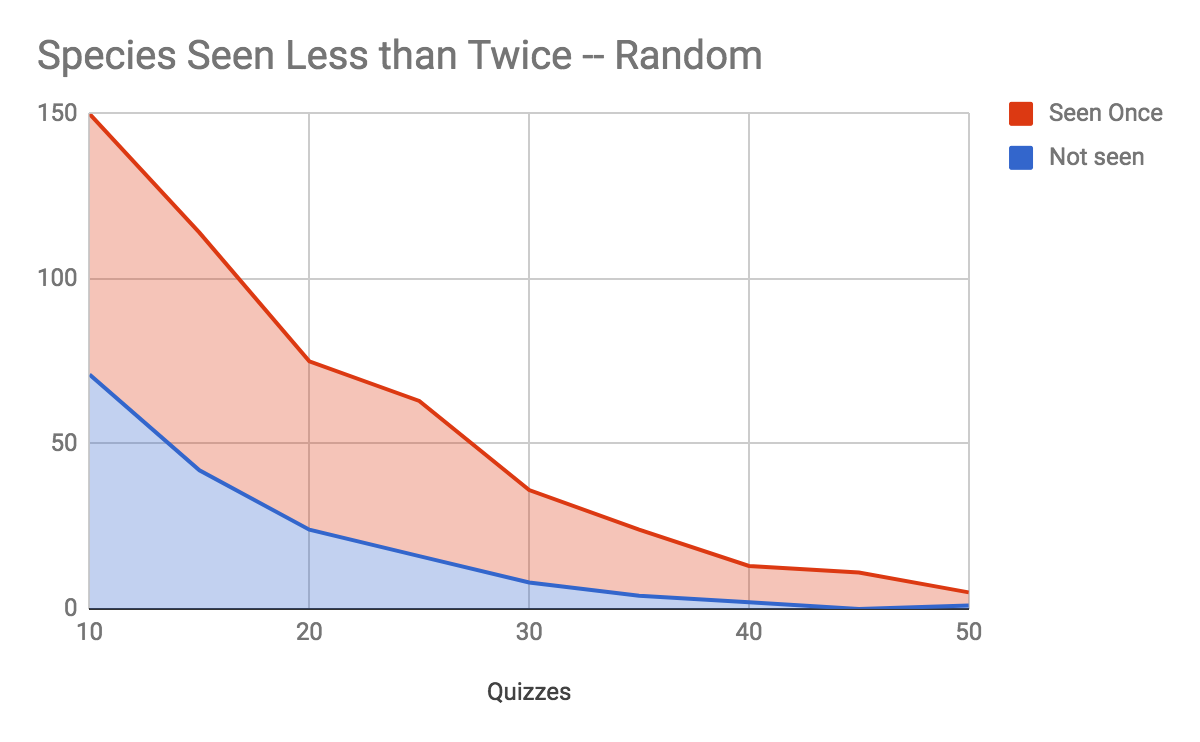

This is a several runs of completely random choosing of species for quizzes. At 10 quizzes the user will only have seen 125 species of the 200. Even at 50 quizzes there are still 4 species the user has seen once, though because of long tails and randomness 40 quizzes should be a better indication at 13 species seen less than twice, or rather no chance to learn the species.


So totally random is not really a great way to go. On the other hand totally not random is an algorithmic nightmare unless handed over to Machine Learning or better: Machine Teaching. But let’s say we need a bit of middle ground. How about just calculating a weighted random selection that favors the species a user hasn’t seen yet? Basically every time the user sees a species, they are a bit less likely to see it. It isn’t a perfect solution, but it would be that much better.
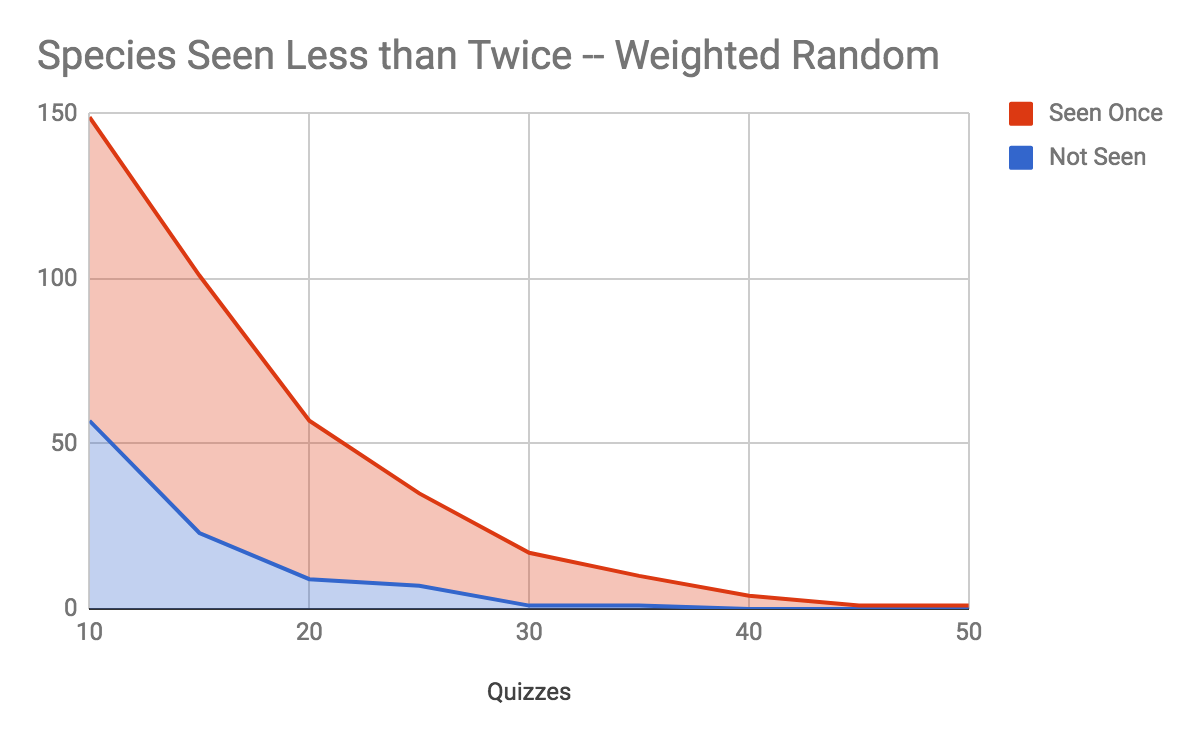

This second approach shows a much steeper decline in the number of unseen species. The tail is still potentially long, but we have a much better chance of seeing more species over the course of fewer quizzes. We are only missing repetition for 57 species after 10 quizzes rather than 75 for the completely random approach. I know this doesn’t sound like much, but 20 species could be significant, especially if they are the most common species.

The second issue is a bit more tame. Essentially we are sorting the possible assets by how many ratings they have and then taking the most recent one with the least ratings. All we really need to do is get rid of the most recent and check for a user’s previous rating on a piece of media. It would take more time, but it could make it that much more rich. Really this is only a problem for species that have very few photos, so go take more! Maybe also unpopular bird species don’t get enough attention in that there isn’t enough turnover to churn-up the number of ratings on a regular basis. Hopefully will see less of the latter with more participants.


Why am I geeking out about this? Well it goes back to when my wife was studying birds for her two jobs doing bird surveys. She hand-built study decks and then reviewed them every night with Anki. Of course that fits in with the spaced repetition from before, but then I started working at the lab and saw how many photos we had, what a treasure trove to build something that could build a set of flashcards from 26k+ Robins, etc.! Starting this was like a dream come true, and through some not-so-dreamy work here we are. It needs some tweaking, but it is still superb.


***


I wrote this back in March before we released the app. The whole idea of the app is to help Macaulay Library to curate data via community ratings. Of course it is pretty close to being a learning app that people can learn birds with, but ML doesn’t want to step on toes. Nine months in we have collected 3 million ratings which helps us to show some of the best photos the community has taken. Ratings were critical in the release of eBird species pages where 6k previously un-curated species had photos and audio chosen if they had any.


I think the biggest wish now is to add a bit of filtering. For instance people might be well-versed in their finches, but want to focus on their shorebirds, even if you are birding locally. Currently with hundreds of species it could take quite a few quizzes to learn all of your shorebirds, though we would get quite a few ratings in the process. It is certainly a possibility, but we have plenty of projects to keep us busy, even for a good part of next year.

I've taken a few more since the start.


Tuesday, December 04, 2018

Conflicted Progress

Read these two articles:


How can these two exist at the same time? One must cancel out the other like antimatter/matter annihilation. Or can they both be right?


Interestingly, I think both are possible, though the “Superpowers” article is mainly writing from the viewpoint of survivorship bias. That is the author is saying that because they did it, so can you, and because you are reading it then they succeeded wildly by following their own rules.


The Farnam Street Blog looks at several cases of Winner Takes All, but doesn’t tell you how to overcome that, except maybe buying several thousand copies of your own book. Does it cancel out the rule-following concept in the more positive article? No, but I think it tempers it quite a bit.


When it comes down to it: We can all improve, maybe even the top performers, but really the only person that would have thought we have superpowers is our former self. Let me frame it with the Recency Effect.


Let’s say that you are a hotdog eating contestant and you can eat ten hotdogs in a minute. You are so good that you have sponsorships and tour the country. Then someone comes along and introduces a new technique and is able to eat one hundred hotdogs in a minute. At the behest of your sponsor you learn the technique and are able to eat one hundred plus one hotdogs, reclaiming your crown.


Being at the top and then reclaiming the top certainly looks like superpowers to folks lower in the pecking order, but even the lightweight packing away only eighty per contest would scoff at your old record of ten due to your new achievement. You might appreciate the difference, but you only really have your initial reaction to gauge just how monumental a jump that is.


All’s good in hotdog-land, but what about starting from the bottom like removing a bad habit? Initially people may notice if it is an obvious habit, but soon it will be old history. Good changes are like a differential for people noticing and hopefully a integral in improving life. That is: people will only really notice as the change is happening, or if asymptotic like a haircut, right after, but then that will be the new normal. But maintaining a good habit like brushing your teeth might literally improve your life expectancy, and no one runs away from conversations anymore.

Self-set rules will only get you so far in becoming the best, the rest is how they relate to your goals, but I think they are a huge step in getting you away from the worst. Rule-following has another name: discipline.

Tuesday, January 23, 2018

Wait, Prepare, Wait

What is probably the worst combination in the history of the world? Promising and procrastinating.

I do this all the time, I promise my wife I will do something, but if I don’t do it right away I forget, or just plain procrastinate. I would like to say that procrastination is doing other things while still having the thing that you need to do in the forefront of your mind, but then I think forgetting about things has just the same effect, although less stressful until you remember. Of course the disappointment in myself is pretty big, but that is dwarfed by the feeling of having disappointed someone else, especially my wife.

Right now, as I write this, I am procrastinating. Sort of. I’ve read through assignment 3 and I need to let it simmer. But I am also waiting for the peer feedback for assignment 2 to be uploaded so that I can get that done for the class. It doesn’t look good for “the drop” tonight. I am also using this moment to write, write “I” enough that I think I might need to edit this.

This is an okay equilibrium at the moment, because it has many layers of preparedness: I am early wanting peer feedback, I have read the assignment a week before it is due and it builds off of the previous one, I am practicing writing which is crucial for this class, and I will update my to-do list before going to practice my cello, then reading and then bed. Right now, everything is under control.

It’s a good feeling, but of course fleeting because this week is going to flit by one way or another.

So is this waiting any better than just getting things done at the last instant? It’s hard to say from this end. Is it temporary motivation that I am chomping at the bit? Have I finally begun to learn discipline? (Note: whenever I think this way I remember all the things that I would like to add to my disciplined schedule and how many things I have failed at already in terms of discipline.)

It’s going to be hard to say from the other end. There is something to finishing something all in one go. Something satisfying about having just finished, and it’s addictive (Wait But Why.) I remember one of my most exhilarating coding days, I knew I needed to write a user interface to test the new receiver in the telescope. I put it off until the day of, and finished, not well, that same day. Here is the description in passing. It made me realize that being an expert at a chosen technology can mean that you can get things out quickly. While that is an awfully nice thought, a better one is getting it done over the course of weeks, consulting with people, and being on-hand for the commissioning.

I still have a problem with discipline at work as distractions are plentiful, but I also can get quite a bit done just being that much more of an expert. Something about having worked for 10 years as of the 21st of January.

There is no perfection in my work. I strive to understand better ways of doing things, new things I come across, but I am much more confident. I wait quite a bit more, but on the other side. I find things to do, things that I should be remembering sooner, and things that may make at least one person’s job easier.

Friday, November 18, 2016

Revisiting Tolerance

I wrote about tolerance a while ago. These sentiments of mine are nearly unchanged, but I think I need to address the specific issue of intolerance and its danger to an otherwise tolerant society. Basically one of the few things we have to be intolerant of is intolerance.

It seems self-defeating, if we are intolerant of intolerance then we are hypocritical. But let’s observe it from a slightly different vantage. Let us draw a hopefully erroneous link between intolerance and violence and say that every person disliking another person to the point of hate based on ethnicity is likely to be violent toward that ethnicity.

If we tolerate their hate but stop them from being violent, what have we accomplished? If we are perfectly omnipresent and can stop the violence before it begins, will the world be better? But we aren’t omnipresent, nor are our imperfect criminal justice representatives, and on top of that there can be threats of violence that can impact a person’s life just as much as a violent act, all the way up to death. You could call it psychological violence, let’s not escalate this too far. Unless the victim has a strong, supporting, understanding community it will likely end up doing just as much harm in the end.

So let’s go one step beyond and curtail the threats, then there will be immediate claims of first amendment violation. And that is where this argument wallows for all time. Everything comes back to the rights of an individual, or so it seems. Both sides start saying terrible things and the debate becomes a conflagration. It is up to the third party on the intolerant’s perceived side of the debate to correct that person. Yes, it is intolerance of a sort, but rather than the intolerance breeding more and more of itself, it is curtailed, one less perceived supporter.

Of course the medium bringing you this blog is probably partly to blame in the ease to which a person might find other people as intolerant as they are, with no way for us to quarantine a person and their brand of intolerance.

So what do we do? Well I have to confess that I have major issues with this thought. It’s not skin color or ethnicity that bother me, it’s beliefs. I will tolerate beliefs that I don’t hold, but it must be mutual. What I don’t want to do is support a advocacy group that is intolerant of other people’s beliefs. But then how can I hold these opposing thoughts? Am I contradicting myself? It would be nice to live in a nice insulated world, which I do in a way, and believe that I can get to know people I meet and respect them for who they are.

Am I going to support advocacy groups that have attacked Christians? If I flat out say “no” then how am I different than Martin Niemöller and his speech turned into poem “First they came…”? I still need to work it out, reflect, pray, and think about it. In the meantime I think it is absolutely imperative that we know what is going on from trusted sources, so I will definitely support NPR to continue reporting on as much as possible.

One major thing that I believe in and am supporting is Science. I might be looked down upon by some intolerant christians, but I believe that we really need strong science in order to understand our world and make it look more and more like the good parts of Star Trek, namely the abolition of material want.

Science is getting a bad rap from so many different groups that it pervades and distorts findings, but this is easier to do because of how many scientists have been corrupted by the need for “positive” findings in the science community. I did go on at length about this topic, but the main point here is that we need to support open and transparent science.

Go to Amazon Smile FAQs and consider listing the Center for Open Science as the beneficiary even if I don’t work for them anymore. Or become a member at the Cornell Lab of Ornithology. Or both!

Thursday, October 22, 2015

Doing Math

There are so many things that I run calculations on it is weird when I can’t because there are too many unknowns.

For instance a budget. Really no problem. Figure out how much we are bringing in, plan for expenses, keep extra money for unknowns, done. No sweat, other than just getting it done. But for some reason planning time is drastically more difficult. In fact my ability to waste time has probably hindered my growth; there are plenty of things on the internet to look at and read. In fact if I am so lucky, you are reading this now.

The problem with time is that you can’t really keep a reserve in an account, it’s use it or lose it, and now. Many people will sacrifice one way of spending time, friends, family, sleep to get ahead or play more games. But that’s just what it is at that point: a sacrifice. In order for an unforeseen time commitment to get its necessary commitment for getting done, it needs sacrifice from some other activity for the push to actually happen.

But there are people who will continue to push, sacrificing their time consistently. Some of these people believe in what they are doing, either that they will get some big payout in the end, or that they will help so many others. Too many do it because otherwise they wouldn’t be able to support their family that they never see.

Both of my jobs since college have been mostly regular, forty hour a week jobs. However, there is the chance that I could spend much more time with the current one. And it is right on the edge of I enjoy this/they don’t pay me enough. I do enjoy my 40 hours a week, and I know I could put in more for some of these projects because over the summer a few weeks I put in eight to sixteen more hours of coding on my masters degree projects. I was lucky in the fact that Jessie was working out-of-town for the weeks, so I didn’t have to worry about spending too little time with her during the week.

But now that the job is over I find it very hard to balance my priorities and I think both school and Jessie suffer because of it. Oh yes, causes me stress and then I waste time and not spending it at least somewhat productively reading, writing, or learning. One thing I read this week has worked on my mind: Inspiration is for Amateurs by Art of Manliness.

With Jessie around I get out of habits and try to schedule my time around hers. This works to some extent but often it leads to me dropping things that I planned to do because I no longer have enough time. On the other hand this balancing also helps me to focus the time I can manage in more productive ways.

But what about the routines mentioned in AoM? I think I am missing out quite severely on my potential because of my lack of routine and lack of discipline. So I must put my foot down and have a routine that allows me to progress and have a regular schedule on which I can build my discipline. It will be harder as the winter months are colder and it is tougher to roll out of bed, but it will also be at a lower cost than other parts of the day. Jessie doesn’t like mornings. She will get up if she thinks it is worthwhile, like for our hike in the park this last weekend, but the morning really starts at 8 for her.

So, although she doesn’t like missing me in the mornings before I go to work, it is still better than staying at work later because I didn’t get in until 9. It is a sacrifice, not eating breakfast with her, but it is somewhat like banking time that I can spend with her in the evening. But it has its other benefits too:

Traffic is lighter if I leave for and leave from work early, the office is quiet and I can get some big rocks (code and such) done before the standup meeting, I am fresh for those tasks and can generally think more clearly than in the afternoon. I just have to continue with the routine, otherwise it will be easy to spend the mornings cozily in bed and then not get home until late in the evening.

I want to become a “creative professional” but I need the discipline and need to set my routine in stone. I love doing math, but I know that my equation needs to be regular in order for me to be more expressive.

Thursday, October 15, 2015

Wellington and Django

There are few things I like more than learning, though Jessie did make a splendid Beef Wellington this evening. Learning has much longer lasting effects than just a perfectly executed dinner that came from me joking that I wanted it for dinner. Okay, dinner was awesome, now to more serious matters.

Seeing as the Django project has been out for the last 10 years, it isn’t really anything new to those who have been developing websites with Python by any stretch of the imagination. For seven of those I have been working on telescopes, not websites, so I only knew of it tangentially when I started to explore Python.

After finishing my previous projects at work, after a big project that took a bit longer than expected, I was given an administration project, using an Admin interface that had been an R&D project for two of our interns over the summer. They are both still around, working part time, so it wouldn’t be nice just to tear up what they had been doing all this time, especially since they are still working on it.

I talked to a few people familiar with Django and through some experiments and more conversations came to the conclusion that adding the module as an app to the Flask project was probably the best idea at the moment. Though typing that it seems to be quite a silly thing to do. However, it is my intention to make the Django app as modular as it can be, so if we decide to rip all of our models out of the website and package them, we could in fact remove the admin app and make it a service, or a “micro-service” if you so prefer.

I just wanted to mention that we got a book for the office: Two Scoops of Django: Best Practices for Django 1.8. It is already a pretty good read and I am only a fifth of the way through the 480+ pages. The Greenfelds definitely deserve the ice cream that the cost of the book will buy.

Wednesday, October 14, 2015

Risk and Reticence

One of my favorite topics is technology. I work everyday with technology, I read news about current discoveries, and I drool over new inventions (and some new products), and dream of the possibilities. Why? I may be a pessimist, I prefer ‘realist’, about situations and being prepared, but I am optimistic about technology and that it can improve our lives.

I was talking to a friend and neighbor the other morning. He was kind enough to give me a ride as my car is in the shop and Jessie is out working. I have been thinking about conversations in general with people and realize that almost all of the conversations fall into complaining about things that will never change incrementally, or being excited by forecasted advances in technology. And I am tired of complaining without result.

The issue came up that technology removes the need to interact on a human-to-human basis. Specifically, self-driving cars will remove the need for us to interact with friends and family that need a ride because they themselves can’t drive. Broadly: we will incur less risk, or investment in those people that need help today. I agree to some degree, but I believe we are shifting risk and have to be willing to interact with others despite the enforced interactions slowly decreasing.

Exoskeletons

My brother is managing the mechanical side of a lab developing exoskeletons to assist people in walking. This is a great technology, imagine people who have never, or no longer have the ability to walk being able to walk independently other than an assistive set of legs. There are people already benefiting from this technology. But pessimistically: what does this mean in terms of interaction? This person being assisted by technology no longer has to ask for the same assistance as they did when they were in a wheelchair. Not so terrible. Really I think that there is really no real risk, in fact it helps these people go many places that the Americans with Disabilities Act never touched before: a friend’s house, trails, and many other places. Of course there is the risk that the battery may fail, or the apparatus may malfunction, but as long as they have a reasonable way to recharge it, like a standard plug, it is several steps above a wheelchair in mobility.

In the future this technology might be expanded to be helpful to people with more widespread paralysis. More independence for basic movement might lead to more ability to socialize.

Self-Driving Cars

Delving deeper into this idea. Everyone could make use of a self-driving car, but let’s look at previous advances in technology that have led this way.
  • Walking to riding
  • Riding to carts/wagons
  • Cars and other transportation
  • Self-driving cars
Each one of these advances we could say has cut down on our self reliance to some degree. Each advance in transport has added layers of support that we need in order for it to function, but it also gives us massive freedom. In fact today’s cars allow us to escape into our own world, even while driving through the real world. Look at a traffic jam, even though there is a shared frustration, each driver has their own music, audiobook, or conversation going on.

All things happening in a car is a distraction to driving, including driving. Looking to see if a lane is clear could mean that you smash into the car in front of you. Essentially we are our own worst enemies, and as a friend mentioned last night: “We put our lives in the driver’s hands.”

By switching to self-driving cars we will become even more reliant on a piece of complex technology to transport us. That is a risk, but to see that as any worse than right now suggests that somehow today’s cars and companies are more reliable than tomorrow’s self-driving cars and producing companies. This is false. Today’s cars are easily hacked/disabled to the point that we could be left with only cars running for people that haven’t upgraded in the last 20+ years or are interested in classic cars.

So what does the convenience of not driving actually shift the risk to? I think there will be many small shifts, but I don’t think that there will be any big risk socially, physically, economically that isn’t already present, and in fact it might allow for distracting conversations to happen in a car that might otherwise cause an accident.

Really Internet?

Yep, technology has allowed more socializing, maybe. Or maybe it is just interactions. I could go into the long debate about how the internet has made people more or less social, suffice it to say that it has certainly been the main technology in promoting asynchronous communication beyond the book, and books have long been blamed for “making” people anti-social.

It is a measure of risks and benefits. In most cases, realizing the risks and countering them is enough, but there are certain technologies that end up riskier than we first thought. Being well informed is our first defense. Developing a well informed, positive, constructive outlook can help.

Monday, October 12, 2015

I do not do what I want to do

I do not do what I want to do

If you do not recognize this, it is okay, you are living life to its fullest. You can move on and ignore these thoughts. However, I do invite you to ponder:

This is part of a longer, pretty confusing, passage in the Bible written by Paul in Romans 8. Maybe it’s just because I am contrarian and like things other people have a hard time dealing with because I also enjoy Ecclesiastes. Despite all of this talk of the Bible, I think that it is extraordinarily practical, even if some claim may that it can only be understood in a religious context.

One more thing before I dive into this and its application. Many people will claim that many parts of the Bible are impractical to be applied in someone’s life outside of being a Christian. In Mere Christianity C.S. Lewis contends that we either have to take Christ as God, or a raving lunatic, never just a “good teacher.” While I agree that believing in salvation through the sacrifice of God is certainly a tall order and colors much of the rest of the book, and I hope more people would believe, but it is false to believe that there can’t be some positive understanding without being a believer. C.S. Lewis is right to say that calling Christ just a “good teacher” is impossible, but basically Christians fall into the pride trap and often look like the Pharisees in their words and actions believing that all the teachings can only be understood through relation with Christ. A humble view will show that, yes, salvation is a black and white subject, and not decided by us, but understanding specific passages can be done.

So what brought up this topic? Partly it was reading Strip or Retire post by Art of Manliness, but also having been in a discussion of this passage recently. What is better: To risk nothing by doing nothing? To risk everything doing something that the only reward is anxiety? Or to risk something or everything in order to do better?

If you read the AOM post I think you will know which one I am pushing toward, but still I am going to see if I can make sense of it.

First and foremost I must admit to being in the first camp. I don’t much like it when I think about it and often times I want to get out. But how comfortable it is to just let the status quo keep its status just where it is. But that is partly why I am writing this, to get myself toward the bank of the river Status; to think critically about subjects and expose my thoughts to a wider audience. This is risk, small but still more than I would otherwise consider normally.

What about that second camp? If we risk ourselves on things that are only going to cause anxiety, why do we do it? And does it really cause anxiety for all people?

The people who take these type of risks get an immediate rush, would anyone jump out of a plane or off a cliff to only see the view? Probably, but most people are doing it for the thrill, even with current technology the threat of death is right there. And to the skydivers, there are no personal consequences, at least insofar as they haven’t already reasoned away, who needs life insurance if you die doing what you love?

But these selfish actions, even as mundane (today, at least) as skydiving, do have consequences for other people. Skydiving is socially accepted, but there are many things that are not which people are taking risks all the time and hurting themselves and others for just an ever-diminishing rush. There are also some things that society views as not as bad as previous generations viewed it. Certainly some of these views may have been wrong, but to stir the fire: We all joke about politicians being liars, and the fact is there is no way they could ever keep all their promises, not unless they become god-like and tyrannical. But the US is currently looking at many candidates for an election that is more than a year away, and seemingly seriously considering a self-proclaimed liar.

I am sure you can attach a name to the man who has taken loans, promising to pay it back, and then those companies have gone bankrupt. Certainly unforeseen circumstances could crash a company once in a lifetime to the point that it requires bankruptcy, but when it becomes a pattern there is obviously some reasoning that allows it to happen again and again. Also the attitude is not one of contrition, but rather bombast. Just the person I want to run the country.

I do not want to move from the nothing camp into the negative side. Yes, I may get things wrong, but I want to be doing things right, for the betterment. Probably not altruistic, but certainly not selfish. And those who are coming with me need to know that there are risks, and the possibilities. But first I need to cut down on the nothing and start finding the risk that will pay dividends in the long run.

Some things that I feel I could invest my time in, either more or at all:
  • People - Right now I only really invest time in one person. And even that I do not do too well.
  • Constructive hobbies - lighting for a shadow box doesn’t happen without a bit of work. Also there are other projects around the house that could use my knowledge and/or quick learning to solve. There might be a bit of risk, but the reward will be a more comfortable, or usable, house.
  • School - I would like to be an expert, and to have done well. I feel like I can actually put more effort into doing well. With my recent post I am considering quitting this semester, does this mean I am no longer taking a risk? Or am I increasing my risk for, hopefully, a better reward?
  • Work - with my first major project taking too long in my estimation, we are switching to an agile system. I am in charge of getting a spam admin page up and going, but I am also angling to take charge of a small team to some extent. I am doing my work, but risking rebuke by trying to organize developers’ efforts.
  • Also work - I had a constructive talk with two of our community team to figure out how I could get better at speaking about COS and developing so that I might be on the shortlist to go to conferences. I really need to start booking myself with local meetups in order to practice my speaking about subjects and hooking the COS pitch. I am not afraid to speak publicly, but what interests me I have found to bore other people.
  • Writing, it sort of goes with the constructive hobbies. If I risk spending my time writing and delaying gratification (no one has clicked on an advertisement yet) rather than getting near-immediate gratification with games, then I could possibly become a better writer and start making money with this whole writing thing, hint, hint. But truly it is a side project.

All of these things are certainly good, but they are hindered by my outlook, I really am not great at taking risks. And reading Johnathan Mead’s blog I really can trap myself into not doing something by over-preparing, or previously visited, over-analyzing.

My biggest issue is the immediate discomfort that I believe I will face. My fight with myself every morning I intend to go running: “It’s too cold/dark, and I won’t do as well as I want.” But after every run, even though it isn’t a race, I am glad I ran. I might not be so happy that I ran too fast, or too slow, but I am glad that I got out there and did it.

Speaking of running, I signed up for a 5k. What does this do for me? It sets a goal, a date that I need to be ready for. Running is nice, a road or trail race isn’t a go/no-go decision, unless injured. Otherwise you can always run the race, maybe not as fast as you want, but I just need to show up and run, and I am a winner!

“Oh no. Everyone who runs can’t be a winner, did he just say that?” Nope, I will most certainly lose unless there is no one else in my age group, however, I gain a bunch of positives: Experience, exercise, a time to beat on my next 5k.

What it really boils down to is taking a risk, or many smaller risks to improve myself for the longer term, hopefully also looking to help others improve, through my example, encouragement, and exhortation.

Wednesday, March 07, 2012

Chugging Along

Getting back into the swing of things.These last few weeks have been pretty horrendous for fencing and running.

Many things conspired to limit fencing, plans and cancellations, but finally got to fence last night. I fenced a bit and practiced some too. After being up the mountain yesterday, and getting up to do 1.5 miles in the morning I certainly wasn't at top performance, however it was definitely good to fence. I certainly need to improve, as we have a person that can soundly beat me. It is quite amazing how much of a motivator that is, in fact it will be an excellent learning opportunity.

I really need to work on my point control, and in that direction I have made a ball with a string through it. Really simple, but attaching a clamp to the beam and then dangling the ball from it should help my point control become better. Or rather I will improve my point control. Another thing is reactions, I need to definitely put in place stock actions as well as leave the door open for flexibility. I see things just fine, but as I get more tired I make bigger actions, which are most decidedly not restful. They also cause pieces of blades to break off and go flying across the gym. So some shopping needs to be done to find a few dry blades, and a glove as mine is finally wearing out, Leon Paul certainly makes great gloves.

I ran 1.5 miles yesterday and 2 miles this morning. I haven't run in 2 weeks mostly because of the rain. I dislike running in the rain, but I made a deal with myself Monday night, I would run at least once a week whether or not it was raining in the morning, Monday being the day. That would allow for my shoes to dry out. But it was actually nice Tuesday morning, so I didn't need to get wet. When I reach 300 miles in my shoes I think they will be relegated as I get a new pair, but I am still about 110 miles from that goal. An old pair of shoes, or just even a second pair that can get wet without worrying about tomorrow.

I also didn't do too well on the most recent self-driving car homework. It wasn't so much programming as putting together matrices for a Kalman Filter. The fact that I didn't have to take linear algebra in college probably doesn't help. Also waiting until the last moment doesn't help either. This week I started in on the lectures so I can hopefully get that done well before this weekend and start in on the homework. It is focused on Particle Filters, supposedly a much easier idea. I sure hope so, but I suspect that we will have to know all three including a histogram discrete filter. It should continue to be interesting, and I am learning python at least.

Featured Post

Allergy

John studied himself in the mirror as best he could through tears. Red, puffy eyes stared back at him, a running nose already leaked just a ...