Showing posts with label work. Show all posts

Saturday, May 22, 2021

Warm May

Utah mountain top view
 I think I broke my step counter. We had a few hikes that added up over the days to over 30k steps in a day and another day that was over 28k. Other days were over 15k pretty easily. Now that I look at it though, my adjustable step goal is just over 10k. Spot on for some questionable science.

That might seem reasonable, except that all through the pandemic I have consistently not even come close to that goal. Some days were below 3k. My body really suffered for it because I was always on edge in terms of not wanting to let my team down. As I have discussed before though: The only way to take care of others well is to (often) take care of yourself first.

There are deep philosophical discussions to be had behind this idea, but I will give two short caveats and an illustration: Never moving beyond yourself is just narcissism, and sometimes it is necessary to sacrifice many things in order to care for or protect someone.

But in general, if you are unable to feed yourself, you will probably be unable to feed another, whether you are unable to procure food today, or don't have the means to ever procure food. In an age-old sense, if you cannot hunt or forage because you are too weak, then those depending on you will starve. Right, so you need to eat, but in a modern sense you should not be denying others just in order to eat...

So back to too much work, essentially health might seem to be tangentially or maybe unrelated to how one works, but if you have ever been sick, hungry, or worried you know that it is hard to concentrate on a task-at-hand that won't alleviate the distraction. Physical health is the same, preventive maintenance means you will reduce the chance of dysfunction.

So I need more steps and I need more exercise. I am looking forward to starting my new Job on Monday. With everything new there is always apprehension, but I think this will be that much better.

My brother-in-law is married off, it was a good wedding. We took some time after and hiked and birded Utah and Idaho, that's where all the extra steps came from.

Also, why is it already summer? It is already too warm, and I need to plant beans, tomatoes, and peppers.

Monday, March 02, 2020

Not Dead Again

Well another hiatus from writing on the blog. I haven’t died, but it was certainly an interesting period of my life. I no longer work at Macaulay Library, that was a weird re-org that seems to be still happening to others as well with less than forthcoming tactics. It still makes me rather upset.

In good news I found a company that was happy to hire me and pay me to be a Senior Software Engineer in August. It is still weird to be a senior anything, but I have found that I do have knowledge that others don’t, though sometimes literally only minutes before they ask. I still have plenty to learn. Quadrant Biosciences is a small startup so there is plenty to do in terms of new software to support the research side of the company. Plenty of challenges left and I hope I am up to them.

I have been reading, as this blog was starting to become a review blog, I really need to start that up. In November I attempted to start another novel for nanowrimo, but only got 15k words in. It is an exploration of a few ideas such as portal technology that may lead to a few of my writings several years ago that I could connect into a universe.

Running last year was pretty good. It was also probably one of the reasons I stayed sane during the false accusations at the Lab. I trained for a Half Marathon and ended up running it in 2:07. There is a possibility of running it again this year, but I am not entirely sure. I am definitely planning on signing up for one somewhere. I also managed to run a 5k in less than 25 minutes, and I plan to sign up for a few more this year to run quite a bit faster. We’ll see.

I am going to see if I can start reviewing sci-fi or other books again, as well as see where my episodes tailed-off. I might also start posting observations about tech, but that might be rather boring for the few readers that actually see this.

Also I realized that with my sporadic writing that continuing to serve ads that may have nothing to do with my content, my interests, or any of my reader's interests that I turned them off. However, if you use the Brave browser you can certainly add me to your sites that you contribute to.

Wednesday, December 05, 2018

Fair Warning

If you ever want to enjoy a movie, radio show, or anything with bird sounds in the background, don’t ever learn bird calls and bird songs. I’ve said this before, either in discussion or maybe even somewhere on this blog. Actually, in counterpoint, when they get it right it really helps set the scene. If you want to start learning bird songs then try this Bird Academy class. Or if you are already somewhat experienced you could try the Quiz.


This quiz that I speak of is actually the project I have been working on the last three months. It is a quiz consisting of mostly unrated media, photo or audio, from the Macaulay Library archives, most of it contributed through ebird. I know it’s sort of like my child, but I absolutely adore it. I already took enough quizzes that I was mostly familiar with 80% of the birds in Japan in May…


I really would like to jump into the spaced repetition, but if as one of the rules in the link says you have to make your own cards, then it would be really hard for us to do with our random species and asset selection. It isn’t totally random, you can pick a place and a time of year. We get a list of likely birds seen in that part of the world, you will be disappointed with Barrow, Alaska in December, and then pick 20 random species. Then we get the photo or audio clip with the least number of ratings and serve up the quiz.


This works well for the most part for well inoculated users, there are terrible tiny photos and misidentified photos, but in general I really can’t get enough of it myself. There are a few issues that I think would make this a better experience for someone trying to use this to learn a new region: Weight the chance to see a species by the number of times you have seen it previously, and try to never show the same photo to the same user if it can be helped.


Let’s say that you are trying to learn birds of the Northeast US. One of them is most certainly the American Robin. At the moment in my area there are getting to be around 200 potential species. If you take the quiz 10 times and see 200 photos then you might have seen the good ol’ Robin about five or six times, and other species on an average of two or three.


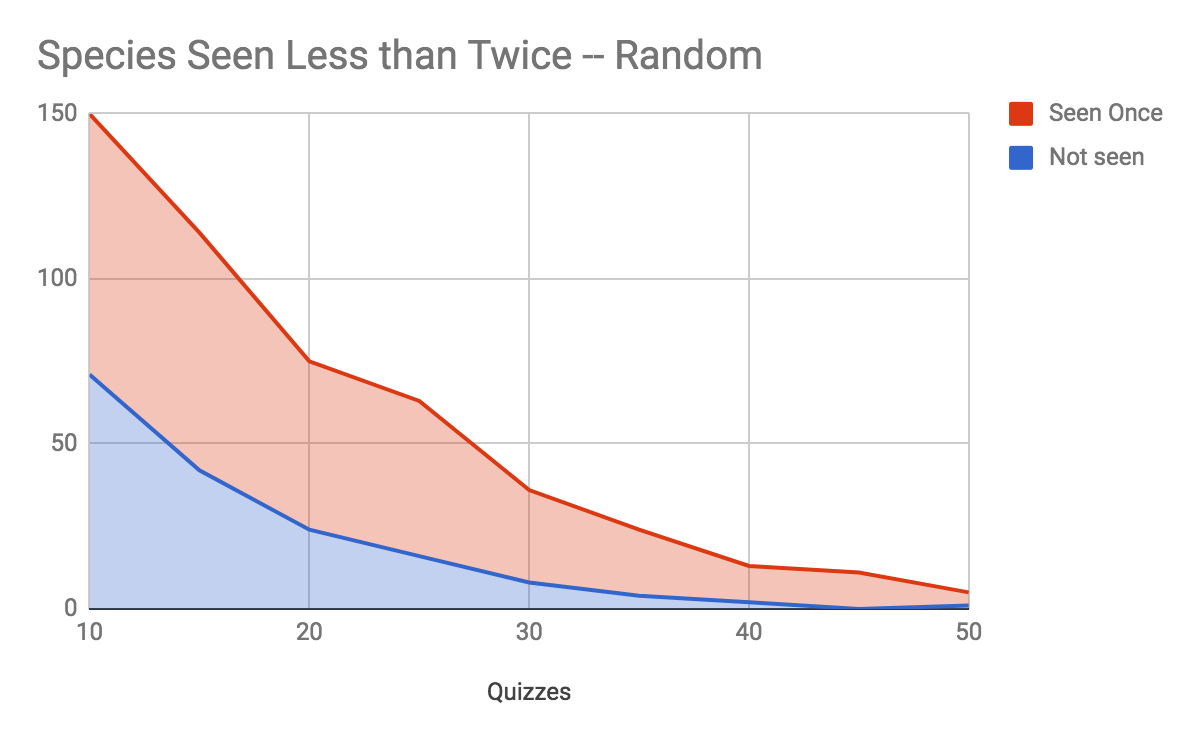
This is a several runs of completely random choosing of species for quizzes. At 10 quizzes the user will only have seen 125 species of the 200. Even at 50 quizzes there are still 4 species the user has seen once, though because of long tails and randomness 40 quizzes should be a better indication at 13 species seen less than twice, or rather no chance to learn the species.


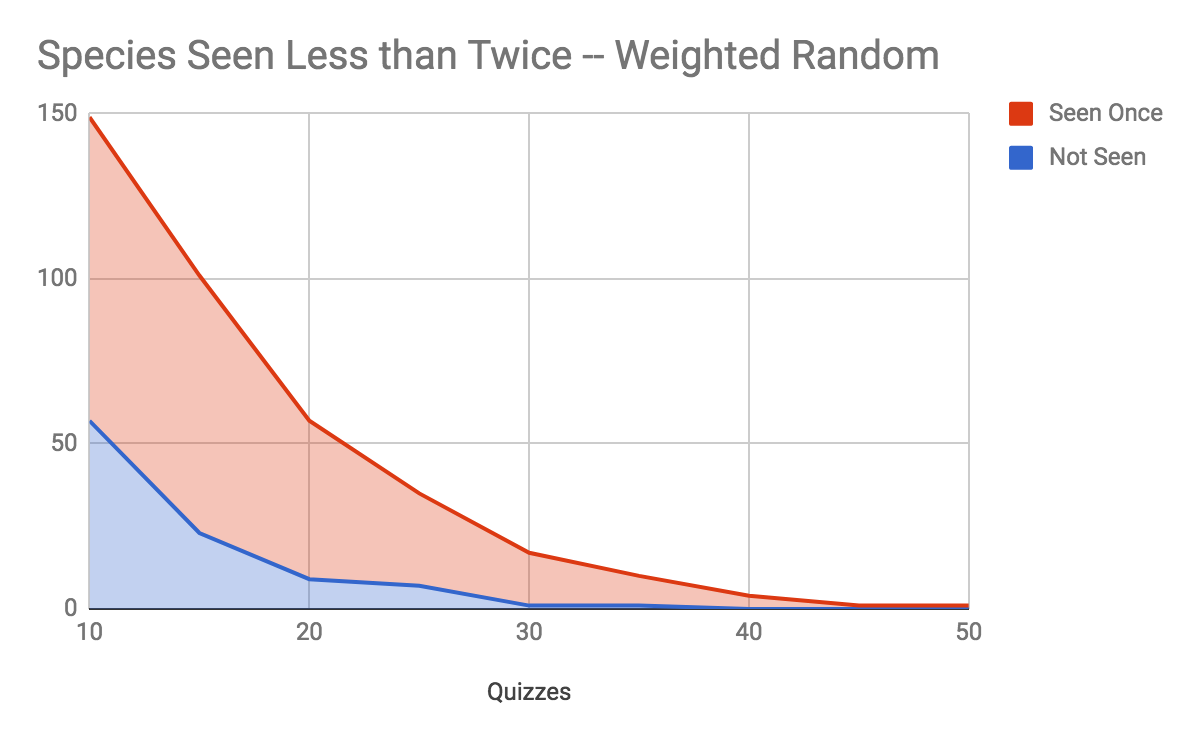
So totally random is not really a great way to go. On the other hand totally not random is an algorithmic nightmare unless handed over to Machine Learning or better: Machine Teaching. But let’s say we need a bit of middle ground. How about just calculating a weighted random selection that favors the species a user hasn’t seen yet? Basically every time the user sees a species, they are a bit less likely to see it. It isn’t a perfect solution, but it would be that much better.


This second approach shows a much steeper decline in the number of unseen species. The tail is still potentially long, but we have a much better chance of seeing more species over the course of fewer quizzes. We are only missing repetition for 57 species after 10 quizzes rather than 75 for the completely random approach. I know this doesn’t sound like much, but 20 species could be significant, especially if they are the most common species.

The second issue is a bit more tame. Essentially we are sorting the possible assets by how many ratings they have and then taking the most recent one with the least ratings. All we really need to do is get rid of the most recent and check for a user’s previous rating on a piece of media. It would take more time, but it could make it that much more rich. Really this is only a problem for species that have very few photos, so go take more! Maybe also unpopular bird species don’t get enough attention in that there isn’t enough turnover to churn-up the number of ratings on a regular basis. Hopefully will see less of the latter with more participants.


Why am I geeking out about this? Well it goes back to when my wife was studying birds for her two jobs doing bird surveys. She hand-built study decks and then reviewed them every night with Anki. Of course that fits in with the spaced repetition from before, but then I started working at the lab and saw how many photos we had, what a treasure trove to build something that could build a set of flashcards from 26k+ Robins, etc.! Starting this was like a dream come true, and through some not-so-dreamy work here we are. It needs some tweaking, but it is still superb.


***


I wrote this back in March before we released the app. The whole idea of the app is to help Macaulay Library to curate data via community ratings. Of course it is pretty close to being a learning app that people can learn birds with, but ML doesn’t want to step on toes. Nine months in we have collected 3 million ratings which helps us to show some of the best photos the community has taken. Ratings were critical in the release of eBird species pages where 6k previously un-curated species had photos and audio chosen if they had any.


I think the biggest wish now is to add a bit of filtering. For instance people might be well-versed in their finches, but want to focus on their shorebirds, even if you are birding locally. Currently with hundreds of species it could take quite a few quizzes to learn all of your shorebirds, though we would get quite a few ratings in the process. It is certainly a possibility, but we have plenty of projects to keep us busy, even for a good part of next year.

I've taken a few more since the start.


Saturday, February 24, 2018

How to Compound a Rainy Day

Watch the solar output when it’s super dark and rainy; it’s like watching your investments tank on a bad market day, but with even less ability to control it. Yeah, but it certainly compounds a sunny day, or even better: mitigates having to stay inside during an incredible day. Okay, barely.


This week I dove into the world of not Numpy with Java, ND4J. I didn’t even get into the ‘N’ of ND4J just keeping to a one dimensional array. Let’s just say that it has many really nice options for dealing with arrays. I will not mention the fact that you cannot easily get an array back to an otherwise usable list in Java without some machinations.


I think that is what I miss most about python in general. Even if a library didn’t have something very specific for a certain community it’s likely the community had someone willing to dive in and make a module that can do it and then posted it. Java certainly has its libraries and all the people using it, but somehow it’s a different community.


When someone asks how to do something there are ten different answers and they must all be encapsulated with a class. Sure if I want to do this again I will move it to a function. If it becomes widespread and is more like an object then I might think about making it a class, but seriously. And then spring… I just want to curl up with some nice classy class based views in Django and leave the mess of Spring behind.

In other news, I ran twice this week. Tuesday and Wednesday were up in the 60s and this morning wasn’t too chilly at 40. If New York only has 2 months of real winter, and it was cold, I guess it’s better for my running. Cloudy, but keeping at around 60% of electricity used produced by solar, ran, and now off to clean something and write my class paper proposal. Content.

Thursday, January 05, 2017

Practice Hurts

With my previous post on gaining expertise I still feel overwhelmed with the amount of stuff I need to learn with this new job. I just switched over an application to use a new database instance/schema. Of course in editing the settings I forgot to make sure it was owned by the right entity so we had a bit of an outage, fortunately only on test.


But that isn’t what I mean by the title. It was more of communications with people, with the office and its 20+ designers, developers, and administrators it is very easy for miscommunication to happen. Yesterday during a weekly standup I mentioned that I would move to the new database, but I ended up working on some alignment issues.


Then this morning I get an email about the test server being down and a short thing about when we should push changes to servers. I haven’t pushed changes since last month, lots of improvements, but still a few issues. So I was a bit surprised, and a bit disgruntled to be told about times to update things…


But this another area where I need to practice. First I checked to make sure I hadn’t accidentally pushed something, looked at the service, and tried to gather more data. Then I sent an email asking about where they got the information since I couldn’t seem to find anything that would point at an update yesterday.


It was still too early. I then found that it was because an account on the database had been disabled late yesterday. I got that back temporarily, but resolved to switch all the servers to the new one. And done.


I know that I have a habit of tearing into people’s assumptions if I have the slightest evidence that they are wrong. This is not the way I should approach it and today was a good example. I managed to reign in my immediate response and gather more data on the situation. I still didn’t allow enough time for me to find the root of the problem and actually write a thorough response, but at least it was not alienating.

Oh, practice hurts especially when it is teaching my ego to take it easy.

Wednesday, January 04, 2017

Worry About It, Later If Possible

It seems like an age since I wrote one of my last posts while still at COS. In it I mention learning, and I really need a bit of a pick-me-up in that area right now. I am very tired from all the constant learning that I have been doing with the new job and the two courses for my Master’s degree. I think I am a bit mad… although it is doable and I am looking at next semester for something similar I really need a reminder as to why this is so hard.

I just finished listening to Freakonomics podcast “How to Become Great at Just About Anything” (which seems to a duplicate title, must be an important thing) and got to thinking about how much time I have put into coding, programming, thinking, and sometimes dreaming about it. Have I put in 10,000 hours? By school alone I would say that I have put in nearly 800 hours. If I take the last two years of work and figure that I have spent around half of that doing solid work, that’s another 2,000 hours. If I add in the robot challenge that started in January and ended in September I put in another 2-300 hours.

So I am around 7,000 hours short of being an expert from a purely number of hours point of view. However, I’ve experienced something very important that Jeffrey Spies, the CTO at COS, thought was extremely important for anybody to experience, especially the people working for him: Gain expertise by struggle.

Just to give you a small taste of contrast let’s take a look at the NASA robot challenge that I participated in. Or rather let’s go even further back to when I was interviewing at Green Bank Telescope in West Virginia in January 2015, that was embarrassing.

They asked me to come up with an idea of how to improve the telescope and how I would implement it, a pretty broad problem, but being familiar with telescope dishes and just having finished helping with aligning the dish for JCMT, I thought I could have a bit of insight. I suggested that the dish alignment could be fixed with Artificial Intelligence. Or Machine Learning. That’s it, I really didn’t have any idea of how to implement this “dish” dream. Unsurprisingly they didn’t like the very spartan answers I gave and I ended up working for COS.

At COS I was thrown into a realm that I had very cursory experience with, as well as starting on my Master’s… Why not have two completely new things at once?

December 2015 my brother was looking for someone to help his team with some computer vision issues for the NASA robot. “Oh yeah, that will be easy, I have heard about that, you just need to do…” And off we went, except that a majority of the starting time after an initial evening of following a few tutorials was spent in my usual way of working on hard problems, just worrying. A majority of the work ended up being in the week or two before the June competition out of near, pure panic. Thank goodness it was on such an even field.

But I knew that September would be harder and I needed to implement actual Machine Learning, not just think about all the wonderful things that it could do. So I started tinkering. By the time the second level of competition rolled around I had a mostly working system to get a model running to check sub-images out of an image.

Between work and competition and, so far, a large majority of my classes in Python I was actually becoming somewhat fluent in the language, so even if I was working down to the last minute on work, competition, or classes I was somewhat confident that I could arrive at a solution for the more fiddly problems. Yes, even if they were out of my immediate understanding.

With the formal Machine Learning course I have come across material that the professors are talking about where I know the bare basics, but they are talking several ideas beyond that. My immediate reaction is the old one: worry about it, later if possible. Maybe that would be a motto that I adopt, it has a nice ring to it, but I really need to toss it out. I cannot do that any more. I am not going to be an expert in a semester, but maybe I can at least have a decent conversation about it, in fact I had one earlier this week with a coworker.

I have quite a bit more stretching to do before I hit the 10,000 hours, but I really need to remember that it does take work and engagement, just like writing. The more I do so, the easier it seems, too bad I didn’t figure that out until after college.

Sunday, November 08, 2015

Suffering is Not for the Faint of Heart

In case you haven't read my byline, I am a Christian. It doesn't mean so many of the things that people think it does, sure some of the rumors are true, but really?

Anyway, I would like to broach the topic of suffering. It's a bit scary to look for a definition to back up my thoughts and find that Wikipedia has a pretty in-depth article on suffering. Most of the time suffering is all about physical pain, Sure I have my aches and pains. Many other times suffering is about the mental issues. People are generally focused on their own problems, and many have issues that need help, and need work.

I could talk about what Christians consider suffering, being persecuted for our religion, but I think that there is a suffering that everyone is subject to in life.

This week has been a tough one for our office. Who hasn't had a tough week at work? My previous job had four years with the possibility of losing funding. Our leadership was extremely supportive throughout the whole process, but I was suffering from a few related issues, despite the support. I was tired of the island, near the end, tired of possibility that I wouldn't have a job, and just all the thoughts about where we would go and what we would do.

I did not handle it well, my work certainly suffered and I regret that I could have done more. But how can we do better? Is there a way to suffer joyfully? I would say that the answer is yes and there is a belief system that could definitely help with this. However, if you don't want to listen to that from me, there are still a few things to consider.

First: Are the people causing you suffering really just trying to make your life miserable? This is a really tough question because most people don't want to think about how the people causing suffering could possibly not be doing it intentionally. If the answer is still yes, even after you try to figure it out, then there is another question to ask: Are they trying to make me suffer just to make themselves feel better? If they are you have much deeper problems and should be considering formal action or moving away from the situation. But in both situations you need to be joyful. There is no other way. Not so obviously "fake" happy, because then you are probably going to try to take things, like revenge, into your own hands. That bent means that you are going to do ridiculous, potentially dumb things just to be able to rub their face in it.

Second: Sitting around wondering what a weird exchange means and being crabby about it is not going to do anyone good. Unfortunately I suffered from this malady on Tuesday and have been a bit slow in connecting my recent knowledge about suffering to this situation. I became overly righteous, condemning the action, not realizing that some leaders aren't leading because they are trained leaders, but rather are in the position because they were there.

Some people are born leaders, sure, some people will get training and be good leaders, some will fail and make mistakes that may seem obvious, and then there are those who will never learn but still have more power than they know how to handle. To put a leader in the fourth category right away without any thought to situation, background, training or lack thereof, and experience, is to write them off. It is not recommended as humans are not perfect representations of their own abilities at all times.

In a situation where there can be no mistakes, maybe putting a new leader in the position will solve the problem. That certainly worked well for Abraham Lincoln after how many generals? The problem is when the leader is seen to be failing at many levels and we are suffering because of it. Is there insight we could lend? Experience leading, pointing out concepts and language that might very well cause suffering?

I could go on about leading, having some experience myself, but we need to get back to suffering.

Third: Are we, ourselves prolonging our suffering because we are comfortable? It sounds strange but it is much easier for us to deal with the current discomfort than to try to imagine stepping out and changing something. I am talking positive change, though there may be suffering in it too. Can we help to alleviate suffering? Can we take the demotivation and turn it into motivation and action? Can we ask for help? Can we leave?

The reason I left the last question to last is because I am afraid of some people answering that question with a "yes." But is is a possibility. To focus on the more constructive, grumbling and moving on is one thing, grumbling and never getting over it but prolonging it just to feel better about grumbling? I am guilty. In a previous post I said that I would not complain without result. I have complained all this last week so now it is time for me to push for the positive change. Learning leaders are just human means that people suffer, knowing they are can help us to suffer joyfully and then help to change the climate.

When suffering at a small scale, such as this is, can be done joyfully, then when the true suffering comes we will have better tools to deal with it. Don't be afraid to suffer, just don't wallow in it, please?

Wednesday, November 04, 2015

Growing Culture

A pre-post edit: I am finishing writing this and editing with the events of Nov 3rd in mind, which were certainly a hugely negative approach to motivating our team that my interest is a bit shaken, or maybe I just have to be more cynical, or less?

The Center for Open Science is growing, and its culture is changing. It sometimes seems like a confusing jumble of all sorts of not quite conflicting interests, but order has been coming to our controlled chaos. In some ways it is awesome, in others it might just deaden things.

I write this as one of our developers is leaving us. He was the first developer hired by the center and laid quite a bit of the groundwork that we use day-to-day. He has his reasons for moving on, but it is still sad to see him go. His enthusiasm really solidified my interest in working for COS, it was serious development, as well as being a serious cause.

I started in February when we had about 30-ish full time staff and many fewer projects going on. There was quite a bit of nebulous thinking with some really nice features that were making the OSF much more of a usable product. There was quite a range of ways to do things, different ideas and lots of freedom to learn and do.

At the beginning of the summer we brought in 35+ interns, doubling our staff numbers and blowing away any possible workflow. Some interns were working on small projects and others were working on large “R&D” projects that may never get integrated into the OSF. Essentially chaos ensued that we are still trying to dig out from under.

We hired a Product Manager and she brought more Agile methods as well as Jira and other ideas. This is certainly still a work in progress but a better definition of how a feature or a fix gets defined, worked on, and merged is a huge improvement over the previous workflow.

Unfortunately with the recent experience and some burnout starting to rear its ugly head, especially with a negative motivation speech to seal the deal and thinly veiled diatribes against the method we certainly need a moment to collect ourselves and our thoughts.

There are two huge projects that are essentially due this month. The problem is with the approach to these projects that it was not managed in such a way that makes much sense.
  • One project was given to an intern. Not that interns can’t do a good job, however, he can’t put in the time when it gets to the point where we need daily turnaround on code review response rather than weekly.
  • This project is now up to 12k lines. By far the biggest chunk of code that has been “through” code review. Why wasn’t it put through in a more piecemeal manner as it was being written? Because it was an R&D project, and though it had people signing off on the proposal, no one was assigned to help the intern bring it up to speed until two weeks ago.
  • Now they are trying to solve the crunch time by putting more devs on it. It may work, but really the fight was lost when it wasn’t converted from an R&D project earlier in the game with more code review done on top of that.
  • Also the full time dev assigned is one of the three code reviewers, meaning that he hasn’t really been able to do code review for other smaller PRs coming through the system.

So I could go on about the negatives of how we aren’t experiencing management in a good way, but I think it is not malicious, just some line of communication was not very clear, and now we are rushing to meet a deadline that we have just learned about.

So my first suggestion is that if the R&D project is ever going to possibly be more than just a learning project then it needs to have definite code and functional milestones where code and functionality can be assessed and reviewed in order for the storm to be avoided when we find out just how close we are to a deadline, at least we will know exactly how the project is going.

We also need everybody doing code review. I know most people aren’t very good at it, but that is why we have more than one level of code review. But three people looking at code that nearly twelve of us produce means that they are always falling behind. Always playing catch-up.

If we have better incremental code reviews with better chunking of the tasks, then we get feedback on smaller bits of code that can be implemented for the next chunk. When 500+ lines of code are changed in a Pull Request, it starts getting troublesome for the more thorough code reviewer to trace down all the implications.

I was going to end this, before today, with an inspirational thought about how we all need to be one of a kind without breaking companies when we leave. But I would like to focus on the more practical. We have a much better, tighter approach than we had before, but we still have some major hurdles to overcome.

Thursday, October 22, 2015

Doing Math

There are so many things that I run calculations on it is weird when I can’t because there are too many unknowns.

For instance a budget. Really no problem. Figure out how much we are bringing in, plan for expenses, keep extra money for unknowns, done. No sweat, other than just getting it done. But for some reason planning time is drastically more difficult. In fact my ability to waste time has probably hindered my growth; there are plenty of things on the internet to look at and read. In fact if I am so lucky, you are reading this now.

The problem with time is that you can’t really keep a reserve in an account, it’s use it or lose it, and now. Many people will sacrifice one way of spending time, friends, family, sleep to get ahead or play more games. But that’s just what it is at that point: a sacrifice. In order for an unforeseen time commitment to get its necessary commitment for getting done, it needs sacrifice from some other activity for the push to actually happen.

But there are people who will continue to push, sacrificing their time consistently. Some of these people believe in what they are doing, either that they will get some big payout in the end, or that they will help so many others. Too many do it because otherwise they wouldn’t be able to support their family that they never see.

Both of my jobs since college have been mostly regular, forty hour a week jobs. However, there is the chance that I could spend much more time with the current one. And it is right on the edge of I enjoy this/they don’t pay me enough. I do enjoy my 40 hours a week, and I know I could put in more for some of these projects because over the summer a few weeks I put in eight to sixteen more hours of coding on my masters degree projects. I was lucky in the fact that Jessie was working out-of-town for the weeks, so I didn’t have to worry about spending too little time with her during the week.

But now that the job is over I find it very hard to balance my priorities and I think both school and Jessie suffer because of it. Oh yes, causes me stress and then I waste time and not spending it at least somewhat productively reading, writing, or learning. One thing I read this week has worked on my mind: Inspiration is for Amateurs by Art of Manliness.

With Jessie around I get out of habits and try to schedule my time around hers. This works to some extent but often it leads to me dropping things that I planned to do because I no longer have enough time. On the other hand this balancing also helps me to focus the time I can manage in more productive ways.

But what about the routines mentioned in AoM? I think I am missing out quite severely on my potential because of my lack of routine and lack of discipline. So I must put my foot down and have a routine that allows me to progress and have a regular schedule on which I can build my discipline. It will be harder as the winter months are colder and it is tougher to roll out of bed, but it will also be at a lower cost than other parts of the day. Jessie doesn’t like mornings. She will get up if she thinks it is worthwhile, like for our hike in the park this last weekend, but the morning really starts at 8 for her.

So, although she doesn’t like missing me in the mornings before I go to work, it is still better than staying at work later because I didn’t get in until 9. It is a sacrifice, not eating breakfast with her, but it is somewhat like banking time that I can spend with her in the evening. But it has its other benefits too:

Traffic is lighter if I leave for and leave from work early, the office is quiet and I can get some big rocks (code and such) done before the standup meeting, I am fresh for those tasks and can generally think more clearly than in the afternoon. I just have to continue with the routine, otherwise it will be easy to spend the mornings cozily in bed and then not get home until late in the evening.

I want to become a “creative professional” but I need the discipline and need to set my routine in stone. I love doing math, but I know that my equation needs to be regular in order for me to be more expressive.

Tuesday, October 20, 2015

Balance Humbleness and Credit

What is more sought after? Praise from someone who seems to praise you at every turn or praise from someone who seems to always be at odds with you?

My wife often praises me for many things, and it isn’t a bad thing, but sometimes it just feels like I would have done it anyway, so I don’t need praise. However, I would rather her continue to offer praise then to cut it all short because I don’t think I deserve it, as in quite a few situations I feel loved because of her words of affirmation. I have to admit that I sometimes am seeking praise from her, but not too often.

On the other hand I have a coworker that often greets my ideas with scoffs or sarcasm. The usual story goes that I would be seeking praise from him because it would be more awesome than anything, but that isn’t true. That is why his praise earlier today caught me off guard. It makes me think of how I regard people, I know that they are probably deep and complex, but really they are just a caricature drawn from my interactions with them or stories I have heard.

In my mind my coworker gained a bit more dimensionality, becoming less of a stereotype that I may have assigned subconsciously, and more of a person. But this whole delving into my mind about assessing characteristics isn’t the whole idea of this post, it is also to look at reactions to praise.

I have a hard time reacting to praise. I grew up and had things easy, school was a breeze, memorizing piano pieces the night before (really wrankled my teacher’s nerves), but also good feedback from family. Praise often came in the form of a ribbon or paper award, all I had to do was accept it and not blush too much.

The ease for which things came to me did not help in the transition to college. With a whole different paradigm I floundered and praise was hard to come by, especially hanging out with kids that were often as smart or smarter than me.

Then after college I had two totally different worlds. My job, where everyone was so smart that I hardly ever was recognized to the people I met who would praise me for things that I thought were general knowledge. And now I was hungry for praise.

Hunger for praise has another name, pride, and it can lead to some odd behaviors. I was overly competitive with fencing and other sports, getting very upset when I couldn’t perform as well as I thought I should. After years of working for the company I thought I deserved to be recognized, but maybe I was lucky that I got to work there at all. Perspectives change greatly.

Jessie confronted me about the fencing. I had to take a breather for months after fencing every week just to calm down enough to realize that I was pushing my stress level up and making mistakes that were hurting both my form and my body. Going into a bout with a mindset of having fun and learning greatly reduced that stress and allowed me to enjoy fencing quite a bit more, as well as be able to use my right hand without too much soreness from a death-grip on the foil.

Back to today, getting praised at work felt weird, especially from an unexpected person. However, self-deprecation won’t really do any good in that instance. Humbleness, sure, but abasing yourself to the point where the person is never going to say anything to you again, much less praise you? It wasn’t that bad, I mostly stuck with saying that it was what I was trained to do. I didn’t go into further detail and left him to draw his own conclusions. Mainly there is credit and yes I am passing credit to my training, but I was there administering it.

It is a tough balance, sure I still want credit for doing good things so that I can advance my career, but I don’t need praise just for praise’s sake, any more. I certainly don’t want to take other’s credit, or attack them in order to advance myself.

If I act too humble then I am proud that I am humble, and if I wheedle praise out of every passerby then I am most certainly proud. Neither of those things will help me grow and understand how I need to interact with other people.

Continue to do good and be humble, credit where credit is due, and don’t over do it.

Thursday, October 15, 2015

Wellington and Django

There are few things I like more than learning, though Jessie did make a splendid Beef Wellington this evening. Learning has much longer lasting effects than just a perfectly executed dinner that came from me joking that I wanted it for dinner. Okay, dinner was awesome, now to more serious matters.

Seeing as the Django project has been out for the last 10 years, it isn’t really anything new to those who have been developing websites with Python by any stretch of the imagination. For seven of those I have been working on telescopes, not websites, so I only knew of it tangentially when I started to explore Python.

After finishing my previous projects at work, after a big project that took a bit longer than expected, I was given an administration project, using an Admin interface that had been an R&D project for two of our interns over the summer. They are both still around, working part time, so it wouldn’t be nice just to tear up what they had been doing all this time, especially since they are still working on it.

I talked to a few people familiar with Django and through some experiments and more conversations came to the conclusion that adding the module as an app to the Flask project was probably the best idea at the moment. Though typing that it seems to be quite a silly thing to do. However, it is my intention to make the Django app as modular as it can be, so if we decide to rip all of our models out of the website and package them, we could in fact remove the admin app and make it a service, or a “micro-service” if you so prefer.

I just wanted to mention that we got a book for the office: Two Scoops of Django: Best Practices for Django 1.8. It is already a pretty good read and I am only a fifth of the way through the 480+ pages. The Greenfelds definitely deserve the ice cream that the cost of the book will buy.

Monday, October 12, 2015

I do not do what I want to do

I do not do what I want to do

If you do not recognize this, it is okay, you are living life to its fullest. You can move on and ignore these thoughts. However, I do invite you to ponder:

This is part of a longer, pretty confusing, passage in the Bible written by Paul in Romans 8. Maybe it’s just because I am contrarian and like things other people have a hard time dealing with because I also enjoy Ecclesiastes. Despite all of this talk of the Bible, I think that it is extraordinarily practical, even if some claim may that it can only be understood in a religious context.

One more thing before I dive into this and its application. Many people will claim that many parts of the Bible are impractical to be applied in someone’s life outside of being a Christian. In Mere Christianity C.S. Lewis contends that we either have to take Christ as God, or a raving lunatic, never just a “good teacher.” While I agree that believing in salvation through the sacrifice of God is certainly a tall order and colors much of the rest of the book, and I hope more people would believe, but it is false to believe that there can’t be some positive understanding without being a believer. C.S. Lewis is right to say that calling Christ just a “good teacher” is impossible, but basically Christians fall into the pride trap and often look like the Pharisees in their words and actions believing that all the teachings can only be understood through relation with Christ. A humble view will show that, yes, salvation is a black and white subject, and not decided by us, but understanding specific passages can be done.

So what brought up this topic? Partly it was reading Strip or Retire post by Art of Manliness, but also having been in a discussion of this passage recently. What is better: To risk nothing by doing nothing? To risk everything doing something that the only reward is anxiety? Or to risk something or everything in order to do better?

If you read the AOM post I think you will know which one I am pushing toward, but still I am going to see if I can make sense of it.

First and foremost I must admit to being in the first camp. I don’t much like it when I think about it and often times I want to get out. But how comfortable it is to just let the status quo keep its status just where it is. But that is partly why I am writing this, to get myself toward the bank of the river Status; to think critically about subjects and expose my thoughts to a wider audience. This is risk, small but still more than I would otherwise consider normally.

What about that second camp? If we risk ourselves on things that are only going to cause anxiety, why do we do it? And does it really cause anxiety for all people?

The people who take these type of risks get an immediate rush, would anyone jump out of a plane or off a cliff to only see the view? Probably, but most people are doing it for the thrill, even with current technology the threat of death is right there. And to the skydivers, there are no personal consequences, at least insofar as they haven’t already reasoned away, who needs life insurance if you die doing what you love?

But these selfish actions, even as mundane (today, at least) as skydiving, do have consequences for other people. Skydiving is socially accepted, but there are many things that are not which people are taking risks all the time and hurting themselves and others for just an ever-diminishing rush. There are also some things that society views as not as bad as previous generations viewed it. Certainly some of these views may have been wrong, but to stir the fire: We all joke about politicians being liars, and the fact is there is no way they could ever keep all their promises, not unless they become god-like and tyrannical. But the US is currently looking at many candidates for an election that is more than a year away, and seemingly seriously considering a self-proclaimed liar.

I am sure you can attach a name to the man who has taken loans, promising to pay it back, and then those companies have gone bankrupt. Certainly unforeseen circumstances could crash a company once in a lifetime to the point that it requires bankruptcy, but when it becomes a pattern there is obviously some reasoning that allows it to happen again and again. Also the attitude is not one of contrition, but rather bombast. Just the person I want to run the country.

I do not want to move from the nothing camp into the negative side. Yes, I may get things wrong, but I want to be doing things right, for the betterment. Probably not altruistic, but certainly not selfish. And those who are coming with me need to know that there are risks, and the possibilities. But first I need to cut down on the nothing and start finding the risk that will pay dividends in the long run.

Some things that I feel I could invest my time in, either more or at all:
  • People - Right now I only really invest time in one person. And even that I do not do too well.
  • Constructive hobbies - lighting for a shadow box doesn’t happen without a bit of work. Also there are other projects around the house that could use my knowledge and/or quick learning to solve. There might be a bit of risk, but the reward will be a more comfortable, or usable, house.
  • School - I would like to be an expert, and to have done well. I feel like I can actually put more effort into doing well. With my recent post I am considering quitting this semester, does this mean I am no longer taking a risk? Or am I increasing my risk for, hopefully, a better reward?
  • Work - with my first major project taking too long in my estimation, we are switching to an agile system. I am in charge of getting a spam admin page up and going, but I am also angling to take charge of a small team to some extent. I am doing my work, but risking rebuke by trying to organize developers’ efforts.
  • Also work - I had a constructive talk with two of our community team to figure out how I could get better at speaking about COS and developing so that I might be on the shortlist to go to conferences. I really need to start booking myself with local meetups in order to practice my speaking about subjects and hooking the COS pitch. I am not afraid to speak publicly, but what interests me I have found to bore other people.
  • Writing, it sort of goes with the constructive hobbies. If I risk spending my time writing and delaying gratification (no one has clicked on an advertisement yet) rather than getting near-immediate gratification with games, then I could possibly become a better writer and start making money with this whole writing thing, hint, hint. But truly it is a side project.

All of these things are certainly good, but they are hindered by my outlook, I really am not great at taking risks. And reading Johnathan Mead’s blog I really can trap myself into not doing something by over-preparing, or previously visited, over-analyzing.

My biggest issue is the immediate discomfort that I believe I will face. My fight with myself every morning I intend to go running: “It’s too cold/dark, and I won’t do as well as I want.” But after every run, even though it isn’t a race, I am glad I ran. I might not be so happy that I ran too fast, or too slow, but I am glad that I got out there and did it.

Speaking of running, I signed up for a 5k. What does this do for me? It sets a goal, a date that I need to be ready for. Running is nice, a road or trail race isn’t a go/no-go decision, unless injured. Otherwise you can always run the race, maybe not as fast as you want, but I just need to show up and run, and I am a winner!

“Oh no. Everyone who runs can’t be a winner, did he just say that?” Nope, I will most certainly lose unless there is no one else in my age group, however, I gain a bunch of positives: Experience, exercise, a time to beat on my next 5k.

What it really boils down to is taking a risk, or many smaller risks to improve myself for the longer term, hopefully also looking to help others improve, through my example, encouragement, and exhortation.


Featured Post

Allergy

John studied himself in the mirror as best he could through tears. Red, puffy eyes stared back at him, a running nose already leaked just a ...